Why Greenland Matters: The Arctic Island at the Center of U.S., European and Global Power Competition
Greenland's location between North America, Europe and the Arctic makes it vital to U.S. missile defense, NATO security and future mineral supply chains. A new security agreement and renewed resource disputes show why the island's sovereignty matters more than ever.
Greenland, a vast Arctic island with a population of roughly 57,000, has emerged as a central concern in the strategic calculations of the United States, Europe and their global competitors.
For decades, its importance was largely measured by its geography: an enormous territory situated between North America, the Arctic Ocean and the North Atlantic, providing an invaluable location for missile detection, military surveillance and transatlantic defense.
Today, that geographical advantage is being joined by other strategic considerations.
Climate change is transforming the Arctic environment. Russia maintains substantial military capabilities across its northern territories. China is pursuing long-term commercial and geopolitical interests in polar regions. Meanwhile, Western governments are searching for new supplies of critical minerals essential to advanced technology, electric vehicles, renewable energy and military equipment.
Greenland sits at the intersection of these developments.
The territory's significance has also become an immediate diplomatic issue.
On September 22, 2026, the United States, Denmark and Greenland signed a far-reaching agreement intended to expand American military operations on the island while preserving Danish sovereignty and Greenland's right to self-determination.
But the tensions did not disappear.
On October 14, President Donald Trump revived controversy by claiming that major American exploration of Greenland's oil, gas and mineral resources was about to begin.
Denmark responded that the defense agreement did not provide Washington with special rights over Greenland's natural resources, and that any commercial activity must comply with Greenlandic law.
The developments reveal three closely connected dimensions of Greenland's importance: its location between continents, its value to Western military defense, and the long-term potential of its natural resources.
Yet the most important question is whether the island can translate growing international attention into security and economic development without surrendering control over its own future.
Geography: Why Greenland Occupies an Extraordinary Strategic Position
Greenland is the world's largest island that is not classified as a continent.
Its territory covers approximately 2.16 million square kilometers, making it larger than Mexico and more than three times the size of Texas.
Despite its immense land area, more than 80 percent is covered by ice.
The population is concentrated mainly along the coast, particularly in the southwest, where the capital, Nuuk, serves as the center of government and economic activity.
From a military perspective, however, Greenland's importance is not determined by its population or economic size.
It is determined by where it stands on the map.
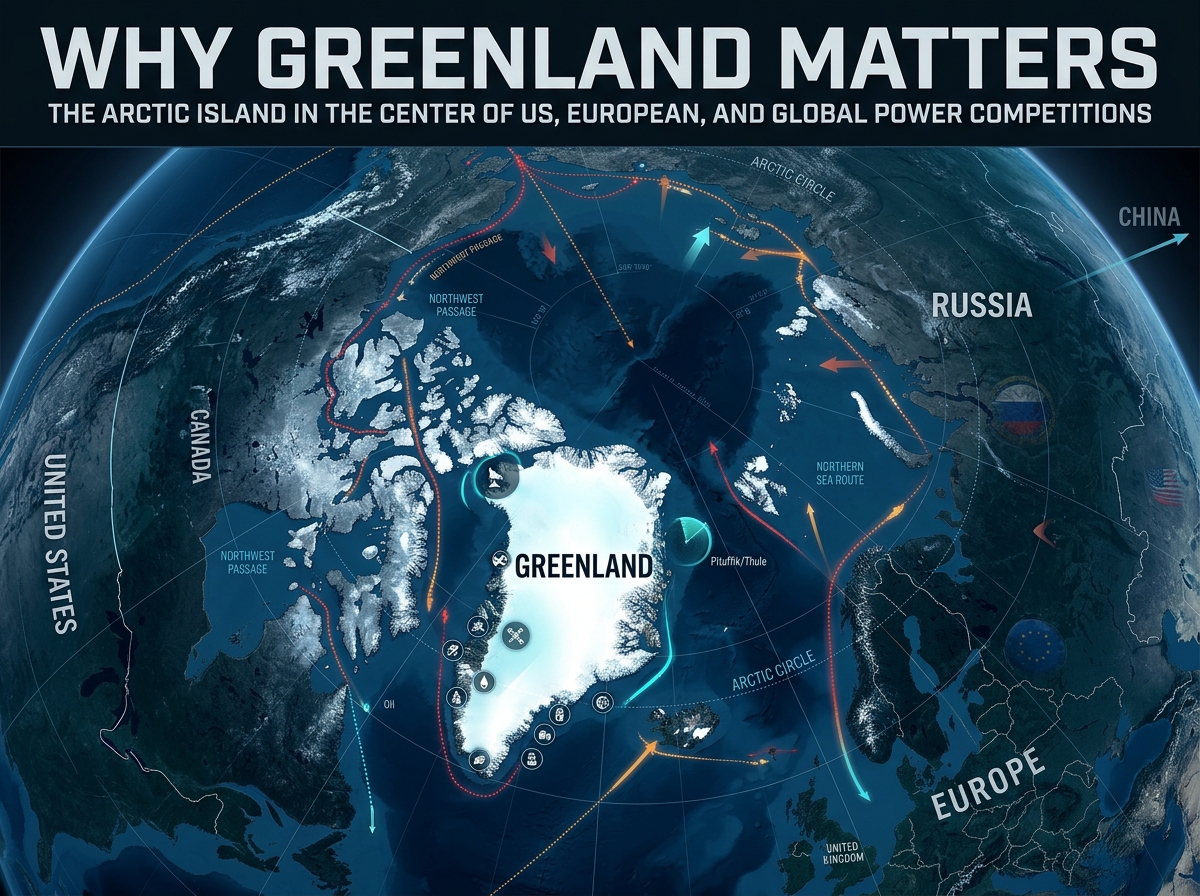
Greenland lies northeast of Canada, west of Iceland and northwest of mainland Europe. Its northern coast faces the Arctic Ocean, while the southern part of the island opens toward the North Atlantic.
This gives it a strategic position along approaches connecting the European Arctic with the North American continent.
During the Cold War, this location was crucial to the confrontation between the United States and the Soviet Union.
Long-range aircraft and intercontinental ballistic missiles could travel across polar regions because routes over the top of the globe can be shorter than routes suggested by conventional world maps.
Greenland therefore became a natural location for early-warning systems designed to detect threats approaching North America.
That geographical reality has not changed.
Although military technology has advanced substantially, the Arctic remains important to missile warning, surveillance, space operations and the protection of transatlantic approaches.
Greenland's location also places it near maritime routes through which Russian naval forces operating from the European Arctic could reach the wider Atlantic Ocean.
For American and European defense planners, monitoring these approaches remains a major strategic priority.
Pituffik Space Base: America's Strategic Military Presence
The clearest demonstration of Greenland's importance to the United States is Pituffik Space Base, formerly known as Thule Air Base.
Situated in northwestern Greenland, approximately 750 miles north of the Arctic Circle, Pituffik is the northernmost installation operated by the U.S. Department of Defense.
Its origins stretch back to World War II and the early Cold War, when Greenland's location became increasingly important for military aviation, meteorological observations and communications.
A 1951 agreement between Denmark and the United States established the legal foundation for the American defense presence.
Today, Pituffik supports several highly important missions.
The first is ballistic missile early warning.
The base hosts a powerful radar operated by the U.S. Space Force's 12th Space Warning Squadron.
This system contributes to detecting and tracking potential ballistic missile threats, providing information to U.S. and allied warning networks.
The second is space surveillance.
Military forces depend on satellites for communications, navigation, intelligence and missile warning.
The ability to monitor objects moving through space is increasingly important as several major powers develop counterspace capabilities.
Pituffik's high northern latitude provides an advantage for monitoring certain orbital paths.
The third mission involves satellite command and control.
Space Force infrastructure at the base supports communication with satellites, including spacecraft operating in polar orbits.
Those orbits are particularly relevant for observing high-latitude regions and supporting global missions.
In modern warfare, these functions extend well beyond Greenland itself.
Early warning, orbital surveillance and satellite communications can support military operations across multiple continents.
That makes Pituffik a strategic asset for the United States and its NATO partners.
Importantly, the base already exists under agreements with Denmark.
American access to this critical facility has not historically required U.S. ownership of Greenland.
The September 2026 Agreement: A New Phase of Arctic Militarization
The strategic relationship entered a new phase on September 22, 2026, when Washington, Copenhagen and Nuuk signed an agreement expanding U.S. defense access.
The arrangement amends and supplements the original 1951 defense framework.
It provides for the modernization and expansion of activities at Pituffik Space Base.
It also allows additional American defense areas at Narsarsuaq, in southern Greenland, and Mestersvig, on the island's east coast, subject to agreement on implementation details.
The agreement establishes broader military access arrangements, including provisions governing American aircraft, vessels, surveillance infrastructure and other defense activities.
It also supports planning related to the proposed U.S. Golden Dome missile-defense architecture.
The significance is substantial.
A larger American presence could improve military mobility, surveillance coverage and logistical support across an increasingly contested Arctic region.
For NATO, the agreement could strengthen coordination among the United States, Denmark, Greenland and other allies.
But its political implications are equally important.
The document explicitly reaffirms Danish sovereignty and acknowledges the Greenlandic people's right to self-determination.
It does not transfer ownership of Greenland to the United States.
Nor does it automatically grant Washington unrestricted authority over the island's civilian economy.
The agreement also provides for restrictions on certain military activities and sensitive investments involving countries outside the NATO framework.
These measures reflect concern that foreign powers could gain influence over infrastructure or sectors considered important to Western security.
As of mid-October, however, the agreement still required the relevant parliamentary procedures before entering into force.
Greenlandic lawmakers have expressed broad support for stronger security cooperation, while some opposition figures have raised questions about financial benefits and implementation.
This is an important distinction between signing a strategic agreement and fully implementing its provisions.
Why Europe Cannot Ignore Greenland
Greenland's place within the Kingdom of Denmark gives its strategic importance a distinctly European dimension.
Denmark is both a NATO ally and an EU member state.
Greenland itself is not part of the European Union, having left the European Community in 1985 following a referendum.
Nevertheless, Greenland maintains formal political and economic ties with the EU.
For European governments, its importance extends across three areas.
The first is North Atlantic security.
Any deterioration in Greenland's security environment could affect the northern approaches to Europe and complicate NATO's maritime defense.
The second is Arctic strategic influence.
European governments have an interest in ensuring that Arctic governance remains subject to international law and established arrangements rather than unilateral territorial claims.
The third is access to strategic raw materials.
European industries are increasingly concerned about dependence on concentrated international supply chains, especially for minerals used in batteries, renewable energy systems, electronics and defense equipment.
Greenland could potentially become an alternative source of some of those materials.
The European Commission has therefore strengthened its relationship with Nuuk.
In November 2023, the EU and Greenland signed a strategic partnership focused on sustainable raw-material value chains.
The Commission subsequently opened an office in Nuuk in March 2024.
These measures demonstrate that Brussels views Greenland as more than a security issue.
It is also a potential partner in Europe's industrial and technological future.
Greenland's Mineral Potential: The Strategic Attraction
Greenland is widely recognized for its geological potential.
Its ancient rock formations contain a variety of minerals that have become increasingly important to advanced economies.
According to the European Commission, 25 of the 34 materials classified by the EU as critical raw materials have been identified in Greenland.
These include deposits and geological occurrences associated with rare earth elements and other industrially important minerals.
The distinction between geological occurrence and commercially recoverable supply is crucial.
Discovering a mineral does not mean that it can be mined profitably or delivered at industrial scale.
Still, Greenland's potential has attracted interest from governments and investors concerned about global supply-chain concentration.
Rare Earth Elements
Rare earth elements are among Greenland's most strategically discussed resources.
Despite their name, rare earth elements are not necessarily scarce in the Earth's crust.
The challenge often lies in finding deposits that can be processed economically and building the industrial systems required to separate and refine them.
Certain rare earth elements are used in powerful permanent magnets.
Those magnets are important for electric-vehicle motors, wind turbines, industrial machinery and military equipment.
Defense-related applications can include aircraft systems, sensors, guidance equipment and specialized electronics.
Minerals such as dysprosium and terbium are particularly important in some high-performance magnet technologies.
Western governments are concerned because China dominates much of the world's rare earth processing and refining capacity.
That creates potential vulnerabilities if trade restrictions, geopolitical disputes or other disruptions interrupt supplies.
Greenland's resources could contribute to diversification over time.
However, mining the raw material would solve only part of the problem.
Without processing and refining capacity, a new mine could remain dependent on industrial facilities elsewhere.
Kvanefjeld and Tanbreez: Two Projects That Illustrate the Challenge
Two rare earth projects illustrate both Greenland's potential and its limitations.
Kvanefjeld, also known as Kuannersuit, has attracted attention because of its substantial rare earth resources.
But the project also involves uranium-bearing material.
Greenland introduced legislation in 2021 restricting uranium extraction, reflecting environmental and political concerns.
Those restrictions created serious obstacles for the project.
A 2026 academic assessment of Greenland's rare earth sector reported that authorities rejected an application relating to renewal of the Kvanefjeld exploration licence in June.
The case illustrates how geological potential can collide with democratic decision-making, environmental regulation and concerns over radioactive materials.
Tanbreez, another prominent rare earth project, represents a different potential development path.
It has attracted international commercial interest because of its mineral composition and the possibility of contributing to alternative supply chains.
Nevertheless, its successful development would require financing, infrastructure, technical execution and viable processing arrangements.
The existence of promising projects should not be confused with a mature mining industry.
Greenland is still far from becoming a major global producer of rare earth elements.
Oil and Gas: Why Trump's Latest Claims Are Controversial
The mineral debate intensified this week after President Trump declared that major exploration for oil, gas and minerals in Greenland was about to begin.
His remarks brought renewed attention to the island's potential hydrocarbon resources.
Geological studies have identified possibilities for oil and gas in parts of Greenland's offshore basins.
But geological estimates of undiscovered resources are not the same as proven reserves ready for commercial extraction.
Drilling in Arctic environments also poses unusually difficult logistical, financial and environmental challenges.
In 2021, Greenland's government stopped issuing new oil and gas exploration licences, citing climate concerns and doubts about the economic viability of extraction.
Some older licence arrangements have generated continuing commercial interest, but any proposed activity remains subject to legal and regulatory requirements.
Denmark's foreign ministry made clear on October 14 that the new defense agreement did not confer special mineral or energy rights on the United States.
This distinction is central to the dispute.
Military cooperation does not amount to permission for unilateral resource development.
The question of who can explore and extract Greenland's natural wealth remains governed by Greenland's legal and political institutions.
Consequently, the suggestion that a large American oil and mineral boom is imminent goes beyond what currently established projects and approvals demonstrate.
Russia and China: Two Different Arctic Challenges
U.S. and European concern about Greenland is partly shaped by the activities of Russia and China.
But their roles should not be treated as identical.
Russia is an Arctic state with extensive northern territory, established military facilities and substantial naval capabilities.
Its Northern Fleet and strategic submarine forces are central to Russian military planning.
The confrontation between Russia and NATO since the full-scale invasion of Ukraine has increased the significance of the Arctic and North Atlantic in Western security calculations.
Greenland's location contributes to NATO's ability to observe and defend approaches to the region.
China, by contrast, is not an Arctic coastal state.
Its interests include scientific research, shipping, energy and mineral opportunities, and broader participation in Arctic economic affairs.
Beijing has described itself as a near-Arctic state and has sought a larger role in polar development.
Western governments worry that certain investments in critical infrastructure could create strategic dependencies or security risks.
Nevertheless, commercial interest and scientific activity should not automatically be presented as proof of military operations.
The security challenge is to distinguish legitimate economic cooperation from arrangements that could compromise sensitive infrastructure or allied defense capabilities.
That distinction is particularly relevant to the new U.S.–Denmark–Greenland agreement, which contains provisions concerning foreign military presence and sensitive investments.
For Washington and Brussels, Greenland represents an opportunity to coordinate their responses to changing Arctic conditions.
For Greenland, it also creates pressure to navigate competing foreign interests without losing decision-making authority.
Faultline Brief Assessment: Geography Gives Greenland Power, but Sovereignty Determines Its Future
Greenland's rising geopolitical importance reflects a wider transformation of global security.
The Arctic is no longer regarded primarily as an isolated region of scientific research and limited military activity.
It has become relevant to missile warning, satellite operations, naval surveillance, commercial routes, energy strategy and competition over critical minerals.
For the United States, Greenland provides an irreplaceable geographical position for monitoring northern approaches and supporting space-based defense systems.
For European NATO allies, the island forms part of the security architecture protecting the North Atlantic and the connection between North America and Europe.
For the European Union, Greenland also represents a possible long-term partner in diversifying supplies of minerals essential to industry and technological development.
But military cooperation and mineral investment are not the same as territorial ownership.
The September 2026 agreement shows that Washington can pursue substantial security access through negotiations with Denmark and Greenland without formally acquiring the island.
Trump's renewed resource claims demonstrate that strategic interests can nevertheless continue to create political tensions over authority and economic rights.
The greatest uncertainty lies in whether cooperation can remain compatible with Greenlandic self-government.
A successful long-term arrangement would need to protect allied security interests while delivering tangible benefits to Greenland's population and respecting its right to determine its political future.
Greenland's most important asset may not be the minerals beneath its ice or even the military facilities on its coast. It is its location at the intersection of North America, Europe and the Arctic—a geographical position that no technological advance or diplomatic agreement can reproduce.
That makes Greenland strategically important to the United States and Europe.
Sources
Follow our reporting: Add Faultline Brief as a Preferred Source on Google →