Binance $6.3 Billion Hack: North Korean Hackers Suspected in World's Largest Crypto Heist
Binance says customer funds are safe after a record $6.3 billion security breach. Investigators suspect North Korea's TraderTraitor hacking group, raising fears over cryptocurrency security, sanctions and nuclear weapons financing.
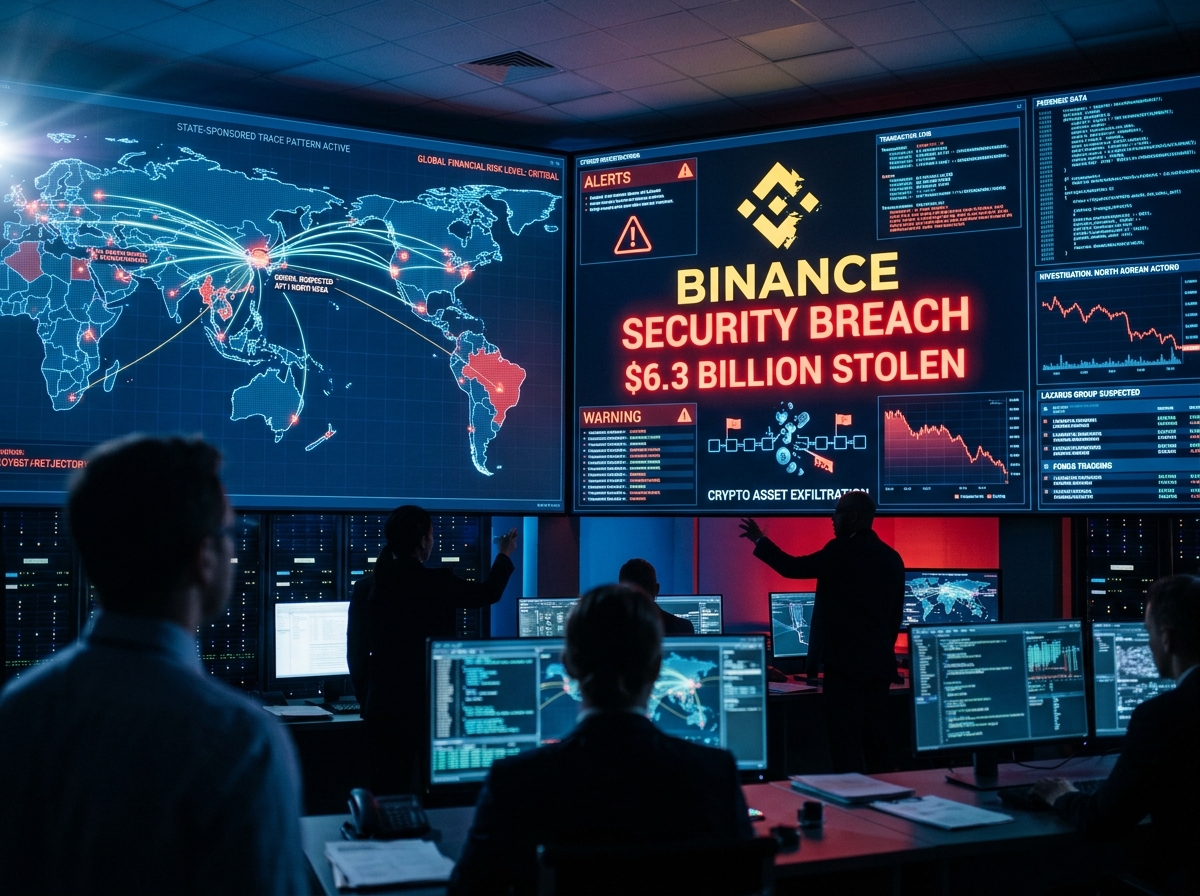
The Binance hack has exposed a major vulnerability in global cryptocurrency security after attackers moved approximately $6.36 billion in digital assets from the world's largest crypto exchange. Blockchain investigators suspect North Korean hackers carried out the October 29 cyberattack, potentially making it the largest cryptocurrency theft in history.
The attack affected Binance wallets across ten blockchain networks, including Bitcoin, Ethereum, Solana and Tron. Most of the stolen assets were transferred within approximately 20 minutes, according to blockchain intelligence firm TRM Labs.
The company attributes the operation with high confidence to TraderTraitor, a North Korean hacking unit associated with earlier cryptocurrency thefts. Binance has not independently confirmed the attackers' identities and says it is cooperating with law enforcement.
Binance estimates the incident's financial impact at approximately $6.3 billion. It says around $3 billion in affected assets have been frozen and promises to cover customer losses using company resources and its Secure Asset Fund for Users, known as SAFU.
But the implications extend far beyond cryptocurrency markets. The suspected North Korean connection raises questions about how cyberattacks could provide sanctioned states with access to billions of dollars outside conventional banking channels.
Also Read This: North Korea Fires 10 Ballistic Missiles
What Happened in the $6.3 Billion Binance Hack?
The cryptocurrency exchange suffered a coordinated security breach on October 29, 2026, when attackers gained the ability to initiate unauthorized transfers from wallets operating on multiple blockchains.
According to TRM Labs, approximately $6.36 billion was moved from Binance-controlled wallets, with most transfers occurring in a concentrated 20-minute period beginning at 20:05 UTC.
The affected networks included Ethereum, Bitcoin, Tron, XRP Ledger, Solana, Arbitrum, Optimism, Base, Avalanche and Polygon.
The scale of the incident is unprecedented. By comparison, the February 2025 Bybit hack involved approximately $1.5 billion in stolen cryptocurrency.
Binance temporarily suspended deposits and withdrawals while conducting security checks. The exchange has emphasized that customer funds remain safe and that it will absorb the losses.
The company has not yet published its final technical investigation, meaning the precise sequence of events remains subject to confirmation.
Who Hacked Binance? Investigators Point to North Korea
The most consequential finding so far concerns the suspected identity of the attackers.
TRM Labs attributes the cryptocurrency theft to TraderTraitor, a hacking operation associated with North Korea.
The company says its assessment is supported by blockchain transaction patterns and additional intelligence, including similarities with previous North Korea-linked cryptocurrency attacks.
TraderTraitor was also identified by the FBI as responsible for the February 2025 Bybit theft.
The Binance attribution has not yet been independently confirmed by law enforcement in this case. That distinction matters because identifying the ultimate beneficiaries of stolen cryptocurrency requires evidence beyond tracing transactions.
Nevertheless, the allegation has transformed the Binance cyberattack into an international security issue.
North Korean hacking operations have repeatedly been accused by US authorities of targeting financial institutions and cryptocurrency platforms to obtain foreign currency.
If the suspected connection is confirmed, the Binance incident would represent a major escalation in the scale of state-linked financial cybercrime.
How Did Hackers Steal Billions From Binance?
Binance's preliminary investigation suggests the attackers may have compromised a DevOps engineer's laptop.
According to the exchange, the intrusion potentially allowed unauthorized access to a service container used to submit withdrawal transactions.
Binance says investigators have found no evidence that wallet private keys were leaked.
TRM Labs identified another significant feature: the attacker obtained valid transaction authorizations affecting wallets on multiple blockchains.
On Ethereum, the attackers exploited an authorization mechanism known as EIP-7702 to delegate control of a Binance hot wallet to malicious software.
A hot wallet is a cryptocurrency wallet connected to the internet and commonly used by exchanges to process transactions.
The attackers reportedly prepared multiple authorizations in advance, enabling them to execute unauthorized transfers when the required conditions were met.
The simultaneous activity across different blockchain networks suggests that the compromise may have affected Binance's transaction-signing infrastructure rather than a single cryptocurrency network.
However, Binance has not established a definitive root cause.
Binance Freezes $3 Billion: Can the Stolen Cryptocurrency Be Recovered?
One of the most urgent questions following the Binance hack is whether the stolen funds can be recovered.
Binance says approximately $3 billion in affected assets have been frozen through cooperation with blockchain partners.
Stablecoin issuers Tether and Circle were among the companies that restricted tokens associated with the suspicious transactions. Ripple and other cryptocurrency infrastructure providers also intervened.
TRM Labs reported that approximately $2.7 billion had been frozen during the early response.
However, frozen assets are not automatically returned to their rightful owner.
Investigators also reported that the attackers converted some holdings into Bitcoin and Ether, which do not offer the same centralized freezing mechanisms as certain stablecoins.
According to TRM Labs, the attackers retained control of approximately $2.4 billion in Bitcoin and Ether beyond the direct reach of token-issuer freezes.
The episode demonstrates both the transparency and limitations of blockchain technology. Investigators can follow many cryptocurrency transfers, but tracing assets does not guarantee their recovery.
North Korean Crypto Hackers and Nuclear Weapons Financing
The suspected North Korean connection is the central geopolitical dimension of the Binance security breach.
North Korea remains subject to extensive international sanctions related to its nuclear weapons and ballistic missile programs.
US authorities have accused North Korean cyber operations of stealing cryptocurrency to generate revenue that can support the country's strategic programs.
The February 2025 Bybit attack demonstrated how a single cryptocurrency breach could potentially generate enormous financial resources for state-linked cybercriminal networks.
A $6.3 billion theft would dramatically increase the scale of that threat.
However, investigators have not established that funds from this particular Binance incident have been transferred to North Korea's nuclear weapons program.
The distinction is essential: suspected attribution does not itself prove the ultimate destination or use of stolen assets.
Even so, the broader security concern is clear. Cyberattacks against cryptocurrency exchanges may allow sanctioned actors to acquire resources that would otherwise be difficult to obtain through regulated financial institutions.
Bitcoin, Cryptocurrency Markets and Global Financial Security
The Binance breach also unsettled cryptocurrency markets.
Bitcoin declined following reports of the incident, while other digital assets came under pressure as traders assessed the potential consequences for exchange security and investor confidence.
The immediate concern is not limited to Binance.
Centralized cryptocurrency exchanges manage enormous volumes of customer assets, making their custody systems attractive targets for sophisticated attackers.
A compromise affecting multiple blockchain networks raises questions about internal transaction approvals, employee-device security and the separation of critical financial infrastructure.
The incident may intensify pressure on cryptocurrency companies to strengthen security audits, restrict privileged access and establish faster emergency-response arrangements.
Regulators could also face renewed demands to improve oversight of digital-asset custodians and international cooperation against cryptocurrency money laundering.
Yet the response to the attack presents a difficult policy dilemma.
The ability of private companies to freeze billions of dollars in digital assets can help contain criminal activity, but it also demonstrates how centralized authority remains embedded within parts of the cryptocurrency ecosystem.
Why the Binance Hack Is a Global Financial Faultline
The Binance cyberattack represents more than a record-breaking cryptocurrency theft.
It illustrates how digital finance, cyberwarfare and geopolitical competition are becoming interconnected.
Cryptocurrency networks can transfer enormous amounts of value across borders in minutes. That capability creates legitimate financial opportunities, but it also offers sophisticated attackers a mechanism for moving stolen assets before authorities can intervene.
If investigators confirm North Korean responsibility, the incident will further demonstrate how cyber operations can become instruments of strategic financial power.
For Binance, the immediate challenge is securing its infrastructure, restoring confidence and ensuring customers do not suffer losses.
For governments, the challenge is preventing international financial networks from becoming channels through which sanctioned actors obtain strategic resources.
For the cryptocurrency industry, the question is whether security systems can keep pace with increasingly sophisticated attacks.
The $6.3 billion Binance hack has exposed a new financial faultline: in an interconnected digital economy, a cyberattack against a private cryptocurrency exchange can rapidly become a matter of international security.
Sources
Follow our reporting: Add Faultline Brief as a Preferred Source on Google →