
Ukraine Nuclear Meltdown Risk Grows as Russian Attacks Threaten Power Grid, Regulators Warn
European nuclear regulators warn that attacks on Ukraine's electricity infrastructure are weakening reactor safety systems, as the IAEA reports repeated power disruptions and emergency generator use at Zaporizhzhia.
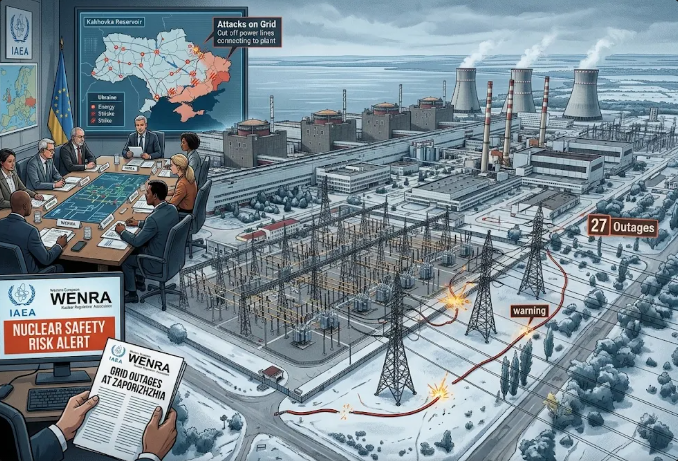
Russia's continuing attacks on Ukraine's electricity infrastructure are raising fears of a wider nuclear safety emergency, with European regulators warning that damage to transmission networks and substations is increasing the risk of station blackouts at nuclear power plants. The International Atomic Energy Agency (IAEA) has reported fresh disruptions at operating reactors and another complete loss of external power at the Russian-controlled Zaporizhzhia facility, highlighting how the war's energy campaign is increasingly intersecting with nuclear safety.
Also Read: Iran Nuclear Program IAEA Warning Deepens Nuclear Weapons Fears as Uranium Stockpile Remains Unverified
Nuclear Safety Threat Extends Beyond Zaporizhzhia
The immediate danger is not limited to missiles striking a reactor building. Modern nuclear facilities depend on reliable electrical connections to operate pumps, instrumentation, control systems and equipment needed to remove heat from nuclear fuel.
In a joint statement, the European Nuclear Safety Regulators Group (ENSREG) and the Western European Nuclear Regulators Association (WENRA) warned that repeated attacks on Ukraine's energy infrastructure had damaged substations and weakened the electricity grid, increasing the possibility of station blackouts.
The regulators also cautioned that repeated losses of external electricity at nuclear facilities were unsustainable because emergency diesel generators were not designed to serve as the principal power source for extended periods.
Their statement, published in April 2026, provides an important regulatory backdrop to the latest November developments.
November Disruptions Reveal Growing Vulnerabilities
On November 14, IAEA Director General Rafael Mariano Grossi reported that instability in Ukraine's electrical grid had forced reductions in power output at some operating nuclear units.
At Zaporizhzhia, all external electricity was lost for more than 12 hours on November 8 after damage to the Ferosplavna-1 transmission line. Four emergency diesel generators automatically started supplying essential safety equipment before the plant reduced the number in operation to conserve fuel.
According to the IAEA, this marked the facility's 27th complete loss of external electricity since the war began in February 2022.
The agency also reported that grid fluctuations had activated emergency diesel generators at several facilities within the Chornobyl exclusion zone.
These incidents demonstrate the vulnerability of nuclear installations to disruption of the wider electricity network, even when reactor structures themselves are not directly attacked.
Could a Nationwide Blackout Cause Nuclear Meltdowns?
A prolonged nationwide power failure would represent a serious nuclear safety challenge, but it would not necessarily trigger immediate meltdowns at every Ukrainian reactor.
A nuclear reactor continues producing residual heat after shutdown. Cooling systems must therefore remain available to prevent fuel temperatures from rising dangerously.
Nuclear plants have multiple protective arrangements, including backup electricity supplies and emergency procedures. The severity of an accident depends on whether these systems remain functional, the condition of the reactor, how long power is unavailable and whether cooling can be restored.
Zaporizhzhia's six reactors have been shut down for years, reducing their residual heat compared with operating reactors. Nevertheless, the site continues to require electricity and cooling for its nuclear fuel and spent fuel storage systems.
In September, the Netherlands' nuclear safety authority explained that even a complete loss of electricity at the long-shut-down Zaporizhzhia plant would not immediately cause fuel damage. It estimated that, under the conditions it assessed, there would be approximately three weeks before an accident situation developed, allowing time for corrective measures.
That assessment cannot be applied automatically to Ukraine's operating reactors, where thermal conditions differ.
The central concern is therefore the simultaneous erosion of multiple layers of protection across several facilities, rather than an inevitable chain of immediate meltdowns.
The Historical Lessons of Chornobyl and Fukushima
Ukraine's nuclear infrastructure carries the legacy of the 1986 Chornobyl disaster, when a reactor explosion and fire released radioactive material across parts of Europe.
The accident resulted from reactor design deficiencies and unsafe operating conditions during a test, rather than a nationwide electricity blackout.
A more relevant historical comparison for the present electricity-supply threat is Japan's Fukushima Daiichi disaster in March 2011.
Following a major earthquake and tsunami, the Fukushima plant lost critical electrical and cooling capabilities. The prolonged inability to remove residual heat contributed to severe core damage and meltdowns in three reactors.
Fukushima demonstrated that the loss of electrical power can become a major nuclear accident pathway when backup systems and cooling arrangements fail.
However, differences in reactor technology, site conditions, protective systems and emergency response capabilities mean that Fukushima cannot be treated as a direct prediction of what would happen in Ukraine.
Russia's War and the Destruction of Ukraine's Energy Network
Since the full-scale invasion in February 2022, Ukraine's power system has experienced repeated waves of missile and drone attacks.
The destruction has affected generating stations, transformers, high-voltage substations and transmission lines.
By November 2026, the problem was no longer simply whether Ukraine could generate enough electricity. Damage to transmission infrastructure was also limiting the country's ability to deliver electricity from functioning power plants to cities, industries and other facilities.
The consequences are particularly serious for nuclear facilities because electricity networks perform two functions: carrying power generated by operating reactors and supplying electricity needed for plant safety systems.
Disruption to either function can force operational changes, while loss of external supply requires plants to rely on backup arrangements.
Zaporizhzhia: A Nuclear Plant Inside a War Zone
Russian forces took control of Zaporizhzhia in March 2022, shortly after the invasion began.
The plant, Europe's largest nuclear power station, has six reactors. Although they are no longer generating electricity, the facility remains dependent on cooling systems, qualified personnel, maintenance and reliable external electricity.
Its position near the front line has complicated repairs to transmission infrastructure.
The IAEA has repeatedly helped negotiate localized arrangements allowing technicians to repair damaged power connections. Yet military activity continues to threaten the infrastructure that has been restored.
Russia and Ukraine have repeatedly accused each other of actions endangering the Zaporizhzhia facility. Independent attribution of individual incidents is not always possible, particularly in contested areas.
The broader risk from attacks on Ukraine's national electricity infrastructure, however, has been documented repeatedly by international nuclear regulators and the IAEA.
Why the Threat Matters Beyond Ukraine
A serious nuclear accident could create consequences extending beyond the immediate plant site, depending on the scale of radioactive releases and prevailing weather conditions.
European governments have therefore treated the protection of Ukrainian nuclear installations as an international safety issue rather than solely a domestic wartime concern.
The European regulators have called for an end to military activities threatening nuclear facilities and their supporting infrastructure.
The IAEA has likewise urged protection of electrical infrastructure essential to nuclear safety and continued cooperation to restore damaged power connections.
The approaching winter adds another layer of difficulty. Electricity shortages affect civilian heating and water systems while also complicating the maintenance and restoration of critical infrastructure.
The Next Nuclear Safety Test
The most immediate indicators to monitor are the reliability of external power connections, emergency generator readiness, diesel reserves, cooling-water availability and the ability of repair teams to reach damaged infrastructure.
The IAEA's November reporting shows that these are no longer theoretical concerns. Ukraine's nuclear facilities have already experienced repeated power interruptions, forced output reductions and reliance on emergency backup systems.
A nationwide blackout would not make reactor meltdowns inevitable. But the continued destruction of the electrical network could weaken the safeguards designed to prevent a manageable disruption from escalating into a major accident.
The central question is whether Ukraine's electricity infrastructure can remain sufficiently resilient to support nuclear safety through another winter of war.
Sources
Follow our reporting: Add Faultline Brief as a Preferred Source on Google →