Space: The Next Faultline in Global Power
As satellites become essential to warfare, communications and economic security, space is emerging as a new arena of geopolitical rivalry. Could the next major confrontation extend beyond Earth?
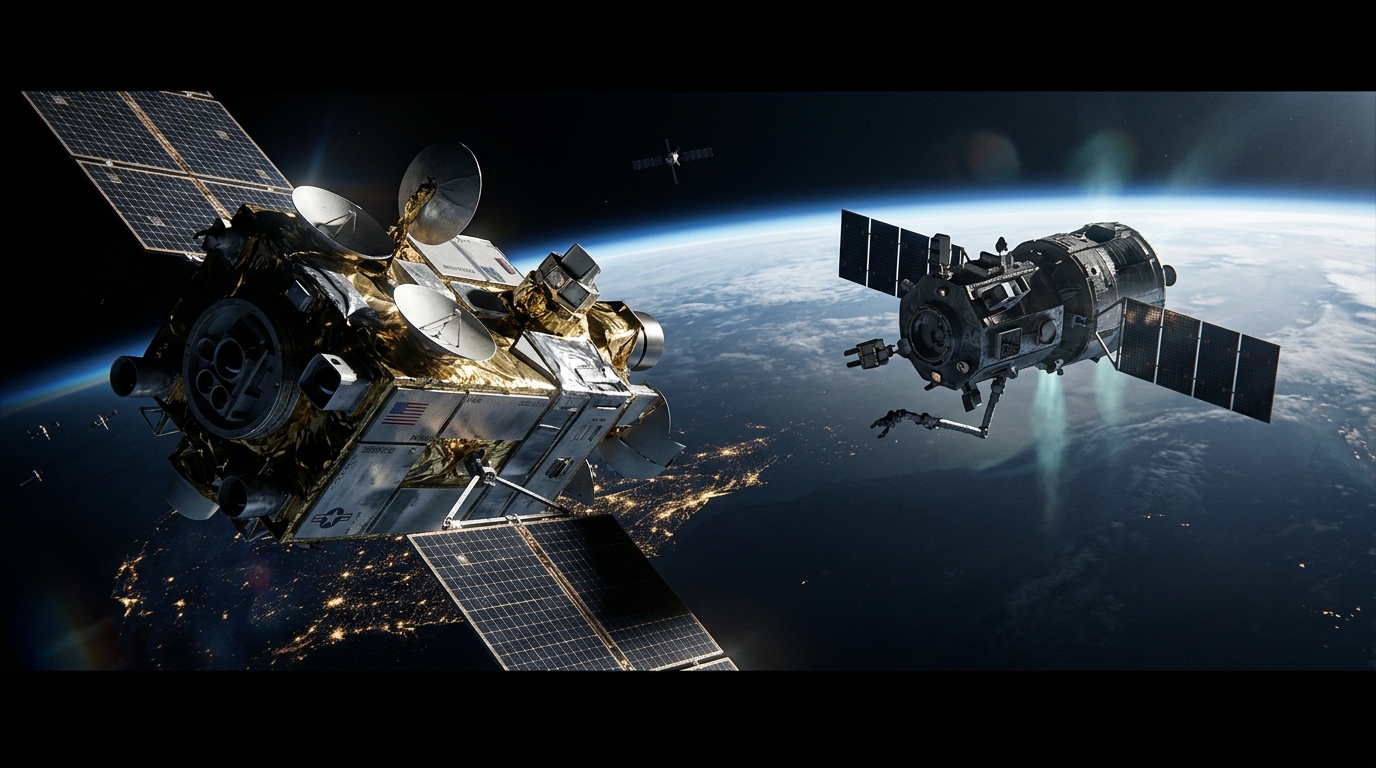
For centuries, geopolitical power was determined by control of land, oceans and airspace. The next great contest may unfold hundreds of kilometers above Earth, where satellites underpin military operations, global communications, navigation and economic activity.
Space is no longer merely a frontier of scientific discovery. It is becoming strategic infrastructure—and potentially a battlefield.
The danger is not necessarily a spectacular war between spacecraft. A future space conflict could begin invisibly, with a satellite disabled, navigation signals disrupted or communication networks compromised.
The question is no longer whether space matters to global power, but whether competition for its control can remain below the threshold of war.
1. Why Space Has Become Strategically Important
Modern societies depend on satellites for GPS navigation, telecommunications, weather forecasting, financial timing, disaster monitoring and military intelligence.
Armed forces use space-based systems to track troop movements, coordinate operations, guide precision weapons and maintain communications.
This dependence creates a vulnerability: disrupting a satellite network can affect operations across enormous distances without directly attacking forces on the ground.
Russia's war against Ukraine has demonstrated the importance of commercial satellite communications and imagery in contemporary conflict.
The distinction between civilian and military infrastructure is consequently becoming harder to maintain.
A satellite built for commercial purposes may simultaneously support humanitarian operations, civilian connectivity and military communications.
That raises a difficult question: if a privately operated satellite helps a military force, can an adversary treat it as a legitimate military target? The answer depends on international humanitarian law and the satellite's actual use, not simply its commercial ownership.
2. The Emerging Space Arms Race
The United States, China and Russia remain central to the competition for military influence in space, while India, European powers and other countries are expanding their capabilities.
The Secure World Foundation's 2026 Global Counterspace Capabilities Report examines relevant technologies across 13 countries.
These capabilities range from electronic jamming and cyber operations to ground-launched anti-satellite weapons and spacecraft capable of maneuvering close to other satellites.
Not every maneuvering satellite is a weapon. Technologies used for inspection, servicing or debris removal can also create security concerns when intentions are unclear.
This ambiguity makes escalation particularly dangerous.
A satellite approaching another spacecraft might be performing a legitimate operation—or signaling a capacity to interfere with it.
Governments may struggle to distinguish between the two during a crisis.
3. How a War in Space Could Begin
A future confrontation might begin without explosions.
GPS signals could be jammed or spoofed. A communications satellite might suffer a cyberattack. An adversary could interfere with imagery or approach a strategically important spacecraft.
Such operations could weaken military capabilities while leaving the attacker room to deny responsibility.
Destructive anti-satellite weapons present another danger.
Destroying a spacecraft can generate debris traveling at orbital speeds, threatening satellites belonging to neutral countries as well as the original target.
An attack intended to disable one military capability could therefore damage the infrastructure of unrelated nations.
The most serious escalation risk emerges when states cannot determine whether an incident was accidental, deliberate or preparation for a larger attack.
4. Orbital Debris: A Threat Without an Enemy
Space is already becoming more congested.
The European Space Agency's 2025 Space Environment Report identified approximately 40,000 tracked objects in orbit and estimated more than 1.2 million debris objects larger than one centimeter.
Even small fragments can severely damage spacecraft because of their extreme relative speeds.
Scientists warn of a potential collision cascade, often called the Kessler syndrome, in which collisions generate debris that causes further collisions.
This is not an inevitable outcome, but growing congestion makes orbital sustainability an increasingly serious challenge.
Unlike conventional battlefields, damage in space can persist long after a conflict ends.
A military confrontation lasting days could leave debris hazards for years or decades.
5. The Moon: The Next Geopolitical Frontier?
Competition may eventually extend beyond Earth's orbit.
The Moon offers scientific opportunities and potentially valuable resources, including water ice that could support future exploration and fuel production.
The United States and its partners are pursuing lunar cooperation through the Artemis Accords, while China and Russia support a separate international lunar research initiative.
These approaches are not inherently incompatible, and cooperation remains possible.
However, competition over desirable landing locations, communications infrastructure, access to resources and operational safety rules could create new disputes.
The 1967 Outer Space Treaty prohibits national sovereignty claims over the Moon and other celestial bodies. Yet questions surrounding resource extraction, commercial activity and overlapping operational areas remain politically sensitive.
The concern is not that countries will legally own lunar territory, but that states establishing infrastructure first may gain practical advantages over later arrivals.
6. Private Companies Are Becoming Strategic Actors
Space power is no longer exercised exclusively by governments.
Companies operating launch vehicles, satellite constellations, communications networks and Earth-observation systems increasingly influence national security.
Commercial innovation has lowered some barriers to space access, while also concentrating important capabilities in relatively few operators.
A private decision about coverage, service restrictions or network availability can carry consequences for governments and armed forces.
This creates a new geopolitical relationship in which states depend on companies they do not fully control.
Private operators also face growing cybersecurity, regulatory and physical-security responsibilities.
7. Can International Law Prevent Space Conflict?
The Outer Space Treaty prohibits placing nuclear weapons or other weapons of mass destruction in orbit. It also restricts military activities on celestial bodies.
However, it does not categorically prohibit conventional military equipment or all military uses of Earth orbit.
Existing international law still applies to space activities, but effective rules for close-proximity operations, interference, debris creation and crisis management remain incomplete.
Reducing danger will require greater transparency, communication between space operators, improved tracking, responsible debris management and clearer expectations regarding hostile behavior.
Smaller spacefaring nations and countries dependent on satellite services also need a voice in those arrangements.
The consequences of a major disruption would be global, regardless of who initiated it.
Faultline Brief Assessment: The Battlefield Above the Battlefield
Space is unlikely to replace land, sea and air as arenas of geopolitical competition. Instead, it will increasingly determine what happens within them.
The states that can protect, replace and coordinate satellite networks may possess major strategic advantages during future crises.
But an uncontrolled contest for orbital dominance could damage the systems on which all countries depend.
The central contradiction is that space infrastructure becomes more valuable as more nations use it—and more vulnerable as rivalry intensifies.
The next global faultline may not be a disputed border on Earth. It may be the fragile network of satellites above us, where a confrontation between powerful states could have consequences for everyone below.
Sources
Follow our reporting: Add Faultline Brief as a Preferred Source on Google →