Riyadh Airport Attack Kills 12, Injures 309 as Saudi–Houthi Conflict Escalates
A deadly attack on Riyadh’s main airport has killed 12 people and injured 309, prompting Saudi threats of retaliation and raising fears of a wider regional confrontation.
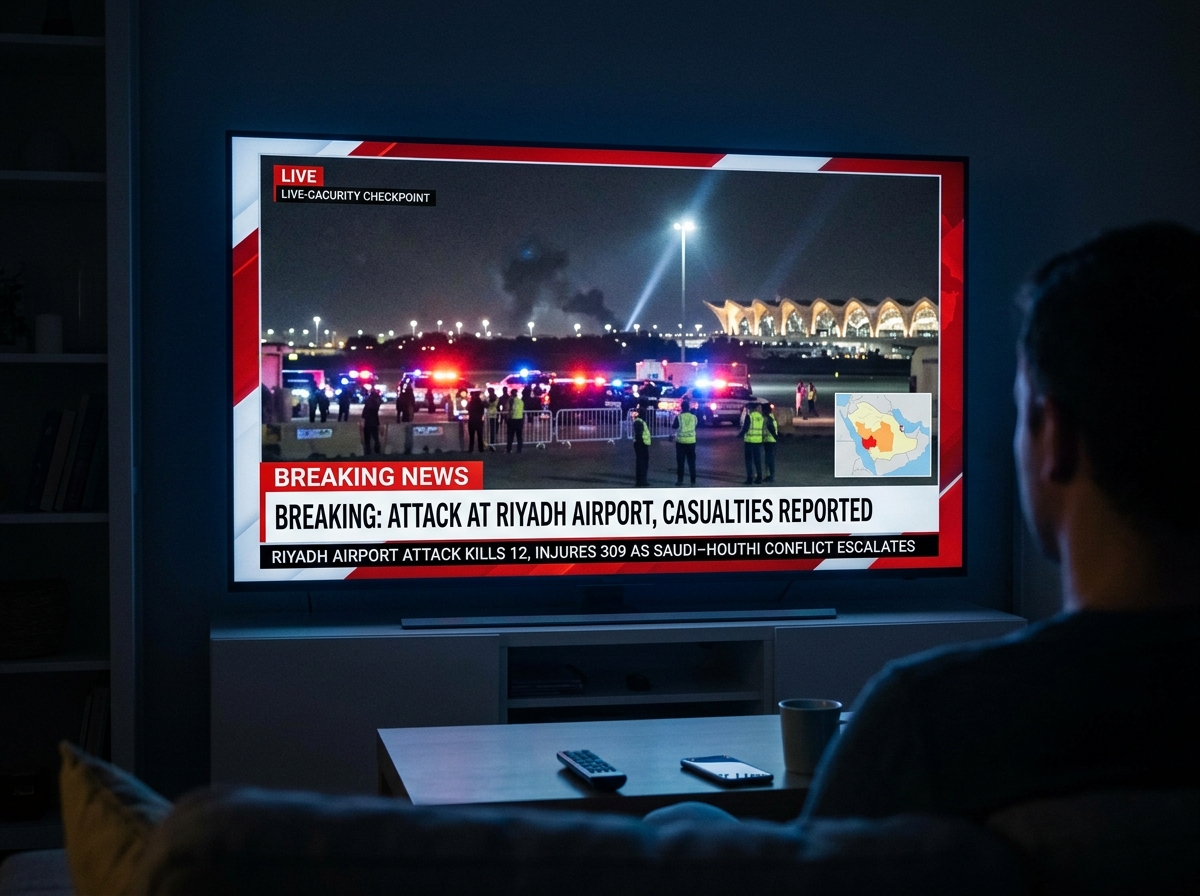
RIYADH, Saudi Arabia — An attack on King Khalid International Airport in the Saudi capital on Saturday, October 10, killed at least 12 people and injured 309 others, according to Saudi aviation authorities, marking a major escalation in the confrontation between Saudi Arabia and Yemen's Houthi movement.
The strike targeted one of the kingdom's most important civilian aviation hubs, forcing the temporary suspension of airport operations, disrupting international flights and prompting warnings from foreign embassies. The Saudi-led military coalition blamed the Houthis and promised a decisive response.
The Houthis, who claimed earlier attacks on the airport during the week, had not publicly claimed responsibility for Saturday's deadly strike in the initial reports reviewed.
The attack raises a critical question for regional security: can the Saudi–Houthi confrontation remain contained within Yemen and Saudi Arabia, or will repeated attacks on civilian infrastructure draw the United States and other regional powers into a broader military escalation?
Twelve Dead, Hundreds Injured
Saudi Arabia's General Authority of Civil Aviation (GACA) confirmed early Sunday that 12 people had died and 309 were injured, including several people in critical condition.
The fatalities included four Saudi citizens, two Bangladeshi nationals, and one national each from the United States, Egypt, Jordan, Syria, Palestine and Sudan.
The international composition of the casualties underscores the vulnerability of major transport hubs, where civilians from numerous countries travel, work and transit through interconnected aviation networks.
Saudi authorities said emergency services were responding to the incident and injured people were receiving treatment at hospitals across Riyadh. Officials also began assessing damage to airport facilities.
King Khalid International Airport is a critical gateway to Saudi Arabia's capital, supporting international business, domestic travel and connections across the Middle East. A major security incident at the airport therefore has consequences extending well beyond the immediate casualties.
Saudi Arabia Blames the Houthis and Threatens Retaliation
The Saudi-led coalition fighting in Yemen attributed the attack to the Houthi movement and characterized the strike against a civilian passenger facility as a war crime.
Coalition spokesman Major General Turki al-Malki pledged a decisive response in accordance with international humanitarian law.
The accusation follows several days of attacks and threats involving Saudi aviation infrastructure.
Earlier in the week, the Houthis claimed strikes against King Khalid International Airport. Thursday's attacks killed three Saudi citizens, according to Saudi authorities, and damaged aircraft.
The sequence suggests that airports and associated infrastructure have become increasingly prominent targets in the renewed confrontation.
Responsibility for Saturday's strike, however, should be distinguished from responsibility for earlier attacks. Saudi officials have blamed the Houthis, while the group had not claimed the October 10 incident in the initial reporting.
Civil Aviation Becomes a Front Line
The consequences of the attack were immediate.
Saudi authorities temporarily suspended operations at King Khalid International Airport while security teams assessed damage and the safety of facilities. Airlines canceled or diverted flights, while foreign governments warned their citizens to avoid the airport.
The United States, United Kingdom and other countries issued travel or security advisories in response to the deteriorating situation.
Beyond the immediate disruption, the attack highlights a broader problem for civilian aviation: airports are large, exposed infrastructure networks that can be difficult to protect against missiles and drones.
Even a limited strike can produce disproportionate consequences, including passenger casualties, airspace restrictions, aircraft damage and widespread disruption to commercial schedules.
Repeated attacks can also force airlines to reconsider routes, increase operating costs and complicate regional air connectivity.
For Saudi Arabia, protecting Riyadh's international aviation infrastructure is both a security imperative and an economic priority.
Washington Faces a New Escalation Decision
The crisis has also increased pressure on the United States.
President Donald Trump said Washington could consider joining Saudi military operations against the Houthis, although he did not announce a decision.
US Secretary of State Marco Rubio condemned attacks against Saudi civilian infrastructure and called for them to stop.
American involvement would significantly alter the confrontation's strategic dimensions.
A direct US military role could increase pressure on Houthi forces, but it could also expand the conflict and expose additional American interests and regional partners to retaliatory threats.
The United States must weigh its commitment to Saudi security and regional stability against the risks of becoming more deeply involved in another Middle Eastern military campaign.
The decision is especially consequential because the Houthis have demonstrated an ability to threaten maritime commerce and infrastructure far beyond their immediate positions in Yemen.
The Red Sea and Bab el-Mandeb Connection
The Riyadh attack cannot be separated from the wider struggle over Yemen and the Red Sea.
The Houthis control significant territory in Yemen and have used missiles, drones and maritime operations to project influence beyond the country's borders.
The Bab el-Mandeb Strait, connecting the Red Sea with the Gulf of Aden, is one of the world's most strategically important shipping passages. Threats to vessels moving through this corridor can disrupt trade between Asia, Europe and the Middle East.
Renewed fighting in Yemen and Houthi advances near strategically important coastal areas have raised concerns about the security of shipping routes and neighboring states.
The combination of attacks on Saudi airports and threats to maritime traffic creates a dual challenge: Saudi Arabia must protect its territory while regional and international partners seek to keep major commercial corridors open.
A prolonged confrontation could therefore affect aviation, maritime insurance, freight costs and wider regional confidence.
Why This Escalation Matters
Three developments make the Riyadh airport attack particularly consequential.
First, the civilian toll is exceptionally severe. Twelve deaths and 309 injuries turn an already dangerous campaign against infrastructure into a mass-casualty incident with international victims.
Second, the target is strategically sensitive. An attack on the principal airport serving the Saudi capital challenges the kingdom's ability to secure critical infrastructure and protect international travelers.
Third, the risk of military expansion is increasing. Saudi threats of retaliation, the possibility of US involvement and the continuing conflict in Yemen create multiple pathways toward a broader confrontation.
The immediate danger is a cycle in which further attacks prompt increasingly forceful retaliation, followed by new strikes against civilian or strategic infrastructure.
At the same time, an escalation is not inevitable. Military decisions, diplomatic intervention and the willingness of the parties to limit their operations will shape the next phase.
What Happens Next?
The most important indicators to watch are Saudi Arabia's military response, any new Houthi claims or attacks, the restoration of normal operations at King Khalid International Airport, and whether Washington moves beyond diplomatic condemnation toward direct military action.
A sustained campaign against Saudi aviation facilities would increase pressure on Riyadh to respond more aggressively.
Conversely, a limited response accompanied by diplomatic efforts could reduce the immediate risk of wider confrontation, although the underlying conflict in Yemen would remain unresolved.
The October 10 attack demonstrates how quickly a regional conflict can acquire international consequences when civilian infrastructure becomes a battlefield.
For Saudi Arabia, the challenge is now to restore security and aviation confidence without triggering an uncontrolled military escalation. For the wider region, the question is whether the Riyadh attack represents the peak of the current crisis — or the beginning of a more dangerous phase.
Faultline Brief | Independent analysis of geopolitics, conflict and security.
Sources
Follow our reporting: Add Faultline Brief as a Preferred Source on Google →