Nvidia Scandal Deepens: China Espionage Allegations, AI Chip Smuggling and the Battle for US Technological Supremacy
Nvidia CEO Jensen Huang faces mounting scrutiny over alleged Chinese intelligence links, multibillion-dollar AI chip diversion schemes and US export controls, as Washington and Beijing intensify their struggle for control of the technology powering artificial intelligence.
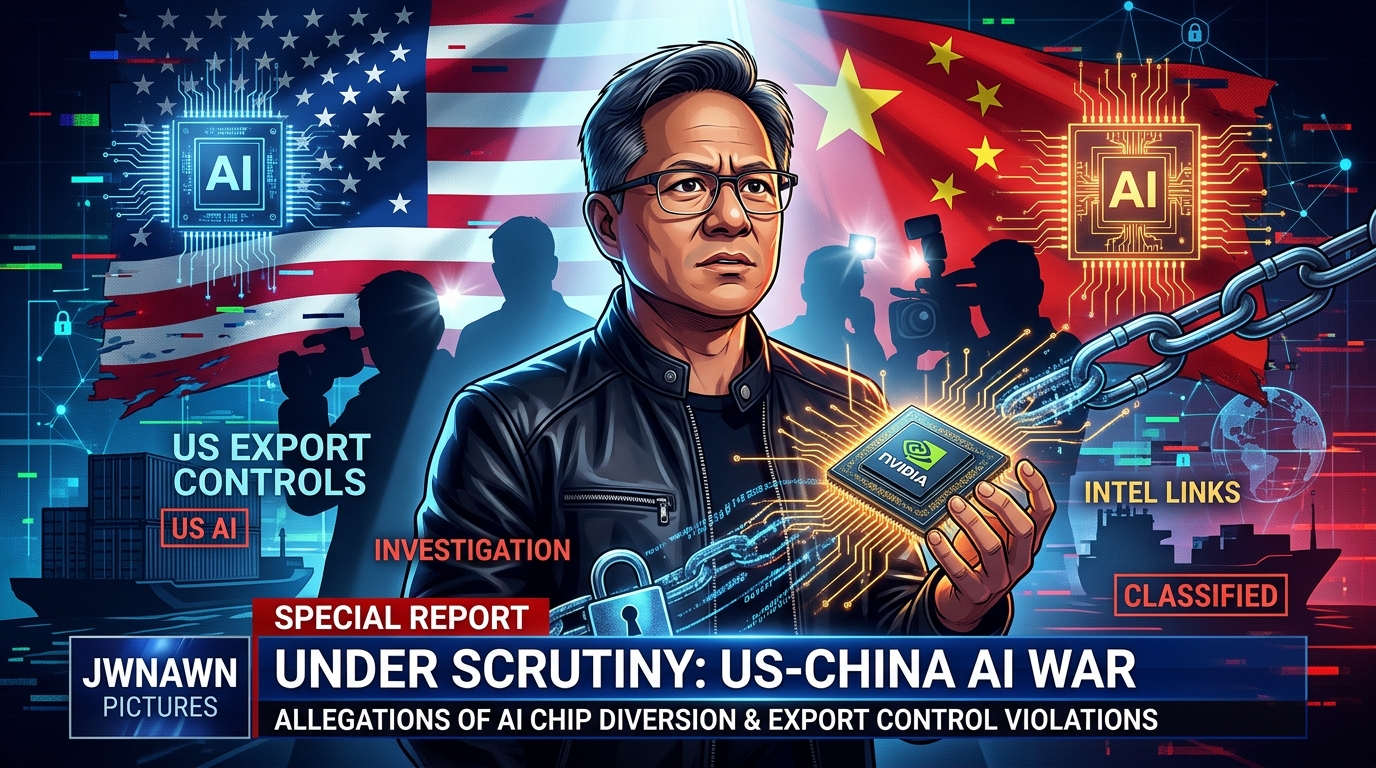
The growing controversy surrounding Nvidia, the American semiconductor company at the center of the global artificial intelligence boom, has developed into a major test of US national security policy, corporate accountability and Washington’s ability to restrict China’s access to advanced computing technology.
At the heart of the dispute are allegations involving Nvidia CEO Jensen Huang’s relationship with a woman suspected by US intelligence officials of having links to Chinese intelligence, investigations into the possible diversion of restricted AI chips through third countries, and growing congressional demands for tougher controls over semiconductor exports.
The allegations remain contested, and neither a foreign intelligence operation against Huang nor corporate wrongdoing by Nvidia has been established. Nevertheless, the controversy has exposed a fundamental vulnerability in Washington’s technology strategy: controlling the international sale of sophisticated AI processors is increasingly difficult when hardware, cloud computing services and corporate supply chains operate across multiple jurisdictions.
Also Read: Could a China–Philippines Clash Draw the United States Into War
The Espionage Allegations Surrounding Jensen Huang
The controversy intensified following reports that US intelligence officials suspected a woman identified as Alice Huang, a former executive associated with Singapore-based AI infrastructure company Megaspeed International, of possible connections to China’s intelligence services.
The allegations attracted particular attention because of her reported personal relationship with Jensen Huang, Nvidia’s co-founder and chief executive.
On November 8, Huang acknowledged to Nvidia employees that he had been unfaithful to his wife. Nvidia’s board subsequently opened an independent investigation into reports that Huang may have been targeted by a foreign intelligence operation.
The company’s board said it had no reason to believe that Nvidia secrets or US national security had been compromised. It retained attorney Joon Kim and the law firm Wachtell, Lipton, Rosen & Katz to oversee the investigation.
China has denied the espionage allegations, while Reuters reported that it could not independently verify the intelligence claims.
The distinction is crucial. A personal relationship, even one that raises legitimate security questions, does not independently establish espionage, the transfer of classified information or deliberate assistance to a foreign government.
However, the episode has intensified congressional scrutiny because Huang leads a company whose technology has become strategically important to the United States.
The Multibillion-Dollar AI Chip Diversion Controversy
The espionage allegations have emerged alongside separate investigations into whether advanced Nvidia processors reached Chinese customers through overseas intermediaries despite American export restrictions.
One prominent case involves Super Micro Computer, a major supplier of AI servers equipped with Nvidia processors.
In March 2026, US prosecutors charged three individuals in connection with an alleged scheme involving approximately $2.5 billion in advanced computing servers, including systems using Nvidia H200 and B200 chips, that were allegedly diverted toward China through a Southeast Asian intermediary.
Prosecutors described methods intended to conceal the destination of equipment and mislead compliance inspections. The allegations include the use of dummy servers and manipulated identification labels.
Supermicro itself was not charged in the case and has said it was cooperating with authorities. The indictment also did not accuse Nvidia of participating in the alleged scheme.
The criminal allegations against individual defendants must be distinguished from proven misconduct by either company.
A separate controversy concerns Megaspeed International, which reportedly purchased billions of dollars of Nvidia-powered equipment.
US authorities have examined whether some of that computing infrastructure was ultimately used to provide restricted technology or computing capacity to Chinese customers.
Megaspeed has denied wrongdoing. Nvidia has also disputed allegations of improper chip diversion and has maintained that it complies with applicable export laws.
The emerging questions are therefore broader than whether a shipment crossed a border illegally. Investigators and policymakers are increasingly concerned about the ultimate users of advanced computing equipment and whether customers in restricted jurisdictions can obtain access through overseas data centers.
Why Nvidia’s AI Chips Matter to US National Security
Nvidia’s processors are central to the development and operation of advanced artificial intelligence systems.
High-performance GPUs, including the H100, H200 and newer Blackwell-based processors, accelerate the mathematical calculations required to train large AI models and run sophisticated inference workloads.
Their importance extends beyond commercial chatbots, search engines and software development.
The same underlying computing capabilities can support intelligence analysis, cybersecurity research, military simulations, autonomous systems and advanced scientific applications.
That dual-use character is why Washington treats leading AI semiconductors as strategically sensitive technology.
US export controls introduced since 2022 have sought to limit China’s access to certain high-performance chips and semiconductor manufacturing capabilities.
The strategic calculation is that restricting access to cutting-edge computing resources could slow the development of AI capabilities with military or intelligence applications.
Yet the effectiveness of that approach depends on whether authorities can identify not only direct exports but also indirect purchases, overseas subsidiaries, intermediaries and remote computing services.
A processor physically installed in Southeast Asia may still provide substantial computing power to a customer elsewhere.
This creates a difficult regulatory challenge: the location of the hardware and the location of the beneficiary are not necessarily the same.
Chinese Military-Linked University Obtains Restricted Nvidia Chips
On November 11, Reuters reported that Northwestern Polytechnical University, a Chinese institution with longstanding links to military-related research, purchased two Nvidia H200 processors despite being on a US export blacklist.
According to procurement records examined by Reuters, the university purchased the chips through a Chinese technology supplier for approximately 874,700 yuan, equivalent to around $123,000.
The university has been subject to American trade restrictions because of concerns involving military research and missile-related activities.
Reuters also identified contracts through which Chinese universities and research institutions obtained access to restricted Nvidia processors by renting computing capacity from domestic suppliers.
The findings suggest that export restrictions may be more difficult to enforce when processors pass through intermediaries or when customers purchase access to computing power instead of acquiring the physical equipment.
The procurement records do not, by themselves, establish that Nvidia knowingly supplied restricted entities or violated export regulations.
The Southeast Asian Connection: A New Front in the US-China Technology War
Southeast Asia has emerged as a strategically important location in the dispute.
Countries including Malaysia, Singapore, Thailand and Indonesia have attracted investment in data centers, cloud infrastructure and AI computing facilities.
For international technology companies, these markets offer opportunities to expand infrastructure outside the United States and China.
But their position within global technology supply chains has also raised questions about export-control enforcement.
American regulators are increasingly concerned that intermediaries or overseas affiliates could obtain sophisticated processors for customers who would otherwise face restrictions.
In May, the US Commerce Department clarified that existing licensing requirements could apply to advanced chips supplied to overseas entities headquartered in China.
The clarification addressed concerns that companies might use foreign subsidiaries to gain access to processors unavailable through direct exports.
This does not mean that Southeast Asian data centers are inherently suspicious or that Chinese commercial customers are necessarily engaged in illegal activity. The challenge is distinguishing legitimate international cloud services from arrangements designed to evade restrictions.
Chinese AI Companies Rush to Secure Overseas Computing Power
The controversy is already influencing commercial behavior.
Reuters reported on November 12 that Chinese AI companies were seeking to reserve Nvidia-powered computing capacity at overseas data centers amid concerns that Washington could impose additional restrictions on remote access to advanced processors.
The demand reflects a growing fear that access to sophisticated AI computing infrastructure could become more limited if Congress strengthens export-control legislation.
Some Chinese companies are exploring offshore capacity, while traders have reportedly increased efforts to obtain restricted processors through unofficial markets.
This creates an increasingly complicated situation for Beijing.
Chinese technology companies want access to Nvidia’s powerful chips to remain competitive in AI development, but the Chinese government also wants to reduce dependence on American technology and strengthen domestic semiconductor manufacturers.
Reuters reported earlier this month that approximately 600,000 Nvidia H200 chips were being held in Hong Kong while Chinese authorities withheld approval for large-scale imports into mainland China.
The reported stockpile illustrates the competing pressures facing Beijing: demand for advanced American computing technology on one side, and technological self-reliance and national-security concerns on the other.
US Congress Moves Toward Tougher Semiconductor Restrictions
The political consequences of the Nvidia controversy may extend well beyond the company.
Lawmakers from both major American parties have called for tighter oversight of advanced semiconductor exports and stronger enforcement mechanisms.
Several proposals have gained renewed attention.
The AI Overwatch Act would increase congressional oversight of decisions involving advanced AI chip exports.
The Chip Security Act would introduce additional tracking requirements intended to make it more difficult to divert restricted processors.
The MATCH Act would seek closer alignment between American export restrictions and those imposed by international partners on semiconductor manufacturing equipment.
Supporters argue that existing controls are insufficient to prevent strategically important technology from reaching restricted end users.
Critics warn that overly broad restrictions could damage American competitiveness, create compliance burdens and encourage Chinese customers to accelerate the development of alternatives.
On November 9, Democratic Senator Elizabeth Warren and Republican Senator Jim Banks called for stronger action on the national-security concerns surrounding Nvidia.
Three Republican House committee leaders have also sought a closed-door briefing with Huang on November 18.
The proposed legislation remains subject to congressional consideration, and its final provisions are not settled.
Nvidia’s Commercial Argument: Restricting China Could Strengthen Chinese Competitors Nvidia has long argued that continued commercial access to the Chinese market can serve American interests.
The company's position is that allowing lawful sales of US technology helps preserve American leadership and keeps international customers dependent on American semiconductor products and software.
The argument has economic and strategic dimensions.
Nvidia’s processors operate within a broader technology ecosystem that includes its CUDA software platform, networking equipment, development tools and relationships with major cloud providers.
Chinese companies that build their AI infrastructure around this ecosystem may remain commercially connected to American technology.
From that perspective, severe restrictions could encourage China to invest more aggressively in domestic alternatives and reduce the long-term influence of American suppliers.
Washington’s national-security advocates counter that maintaining commercial relationships should not take priority over preventing restricted entities from acquiring computing capabilities with potential military applications.
Neither argument resolves the central enforcement question: how to permit legitimate international technology trade while preventing prohibited end uses.
What the Scandal Means for the Global AI Industry
The immediate consequences extend to Nvidia’s reputation, governance and relationships with policymakers.
The company’s board investigation will face questions about whether corporate security procedures were adequate, whether executives disclosed relevant risks and whether confidential information was compromised.
Separately, export-control investigations may prompt closer scrutiny of Nvidia’s distributors, server manufacturers and major international customers.
For cloud providers, new restrictions could increase the cost of verifying customer identities, corporate ownership and the ultimate use of computing resources.
For Chinese AI developers, tighter controls could make overseas computing capacity more expensive or less accessible.
For American technology companies, the risk is that increasingly complicated restrictions could create uncertainty over which international transactions are permitted.
The broader industry could also face growing pressure to introduce technical safeguards that verify the location and authorized use of advanced processors.
Such measures would raise difficult questions about cybersecurity, commercial confidentiality and the practicality of monitoring sophisticated hardware after it enters international supply chains. The Geopolitical Stakes: Who Controls the Future of Artificial Intelligence? The Nvidia controversy highlights a larger transformation in the relationship between technology and national power.
For much of the modern digital economy, semiconductor competition was primarily associated with manufacturing capacity, commercial innovation and market share.
Artificial intelligence has changed that calculation.
Advanced computing infrastructure is now treated by major powers as a strategic resource with implications for economic productivity, military capability, intelligence collection and international influence.
The United States retains major advantages in advanced chip design, software ecosystems and parts of the semiconductor supply chain.
China, meanwhile, has made domestic AI and semiconductor development a strategic priority.
Export restrictions are intended to preserve Washington’s technological advantages, but their success depends on international enforcement, cooperation with partners and the ability to address new methods of obtaining computing power.
The Nvidia controversy demonstrates that restricting the physical shipment of processors may no longer be sufficient when AI computing can be purchased remotely from facilities operating across borders.
What Happens Next?
Several developments will determine whether the controversy becomes a lasting corporate and geopolitical crisis.
Nvidia’s independent board investigation could clarify the circumstances surrounding the alleged intelligence concerns and whether any company information was compromised.
US congressional inquiries could reveal more about export compliance, overseas customers and the adequacy of existing safeguards.
Criminal proceedings involving alleged chip diversion will determine the legal responsibility of the individuals charged, while any additional enforcement actions would need to establish wrongdoing through evidence rather than suspicion.
Washington must also decide how aggressively to regulate access to AI computing infrastructure outside US territory.
Beijing, meanwhile, faces a difficult strategic choice between maintaining access to American processors and accelerating the transition toward domestic alternatives.
Conclusion: A Scandal That Exposes the Limits of the AI Chip War
The controversy surrounding Nvidia is no longer simply a question about the conduct of its chief executive or the movement of restricted semiconductor equipment.
It has become a test of how effectively the United States can govern technology that is commercially global but increasingly central to national security.
The espionage allegations remain unproven, and the existence of chip-diversion investigations does not establish that Nvidia knowingly violated American law.
Yet the underlying strategic problem is real: advanced AI computing power can move through complex international supply chains, overseas data centers and remote-access arrangements that challenge traditional export-control systems.
For Washington, the question is whether stronger enforcement can protect sensitive technology without undermining the global competitiveness of American companies.
For Beijing, the challenge is whether China can reduce dependence on foreign processors quickly enough to sustain its AI ambitions.
And for Nvidia, the immediate task is to restore confidence in its governance, security procedures and compliance systems while navigating the increasingly politicized global semiconductor market.
The central fault line is becoming clear: the contest for artificial intelligence leadership will be decided not only by who designs the most powerful chips, but also by who controls access to the computing power they provide.
Sources
Follow our reporting: Add Faultline Brief as a Preferred Source on Google →