Myanmar Civil War and 2027 Elections: Military Rule, Resistance and Risks
Five years after Myanmar's military coup, a military-backed government faces continuing armed resistance, widespread displacement and questions over political legitimacy ahead of the April 2027 by-elections.
Myanmar's political and military crisis has entered another uncertain phase. The country is preparing for parliamentary by-elections scheduled for April 4, 2027, following a general election that brought the military-backed Union Solidarity and Development Party (USDP) to parliamentary dominance. Yet the electoral process has not resolved the armed conflict that began after the military overthrew the elected government in February 2021.
The central question is whether a government operating under military-backed political institutions can establish lasting stability while resistance movements and ethnic armed organizations continue to contest its authority across substantial parts of the country.
Historical Background: The Roots of Myanmar's Conflict
Myanmar's modern political instability dates back to independence from British colonial rule in 1948. The newly independent country inherited deep political divisions involving ethnic identity, territorial autonomy and the distribution of power between the central government and minority regions.
Armed conflicts emerged soon after independence, particularly in areas inhabited by ethnic minorities seeking greater self-government.
In 1962, General Ne Win seized power in a military coup, beginning decades of authoritarian rule. The armed forces, known as the Tatmadaw, subsequently became the country's dominant political institution.
Mass demonstrations in 1988 challenged military rule, but the authorities suppressed the uprising. The military also refused to transfer power following the opposition National League for Democracy's electoral victory in 1990.
Political reforms beginning in 2011 created an opening for civilian participation. In 2015, the National League for Democracy, led by Aung San Suu Kyi, won a decisive election victory.
However, Myanmar's 2008 constitution preserved substantial military influence. The armed forces retained a quarter of parliamentary seats and control over important security institutions.
This arrangement produced a hybrid political system in which civilian leaders exercised authority but the military retained significant constitutional and institutional power.
The 2021 Military Coup and the Beginning of Nationwide Resistance
On February 1, 2021, the military detained Aung San Suu Kyi and other civilian leaders, overturning the results of the November 2020 general election.
Military leaders alleged widespread electoral irregularities, while the National League for Democracy rejected those allegations. Independent election monitoring did not substantiate the military's claims of fraud on a scale sufficient to invalidate the result.
The coup triggered demonstrations, strikes and a nationwide civil disobedience movement.
Security forces responded with arrests and lethal force. As peaceful resistance faced repression, armed opposition expanded across the country.
The National Unity Government (NUG), formed by opponents of the coup, sought to establish an alternative political authority. People's Defense Forces (PDFs) emerged in multiple regions, sometimes cooperating with long-established ethnic armed organizations.
The conflict gradually developed into a nationwide civil war involving numerous military and political actors.
Major Armed Groups and the Changing Battlefield
Myanmar's conflict cannot be understood as a simple confrontation between two unified armies.
The military retains important conventional capabilities, including aircraft, artillery, armored vehicles and established command structures.
Its opponents include the NUG-aligned resistance, locally organized PDFs and ethnic armed organizations with distinct political objectives and territorial interests.
The Arakan Army has emerged as a significant military actor in western Rakhine State. In northern Myanmar, the Myanmar National Democratic Alliance Army and Ta'ang National Liberation Army have played important roles in fighting and territorial contests.
The Kachin Independence Army and Karen National Liberation Army are among the longer-established ethnic armed forces operating in other parts of the country.
Although some organizations cooperate against the military, their relationships, objectives and approaches to negotiations differ.
A major turning point came in October 2023, when the Three Brotherhood Alliance launched Operation 1027 in northern Shan State.
The offensive exposed weaknesses in the military's territorial control and demonstrated the growing capabilities of ethnic armed groups and their resistance partners.
Subsequent fighting across Myanmar has produced shifting front lines rather than a single stable division between government and opposition territory.
Myanmar's 2025–2026 Election: What Changed?
Myanmar held its first general election since the 2021 coup in three phases, beginning on December 28, 2025, and continuing on January 11 and January 25, 2026.
The USDP, a party closely associated with the military establishment, won a commanding parliamentary majority.
The election took place under conditions fundamentally different from the 2015 and 2020 votes.
Aung San Suu Kyi remained detained, the National League for Democracy had been dissolved, and several conflict-affected areas could not participate.
The military-backed authorities presented the election as a pathway toward political stability and a return to constitutional government.
Critics, including international human rights organizations and several governments, argued that the exclusion of major opposition forces and restrictions associated with the conflict undermined the credibility of the process.
The Association of Southeast Asian Nations declined to endorse the election as a regional organization.
In April 2026, former military commander Min Aung Hlaing became president under the new political arrangement.
The transition altered the formal structure of government, but it did not bring an end to armed resistance or resolve the country's underlying political divisions.
April 2027 By-Elections: A New Political Test
Myanmar's election authorities have scheduled by-elections for April 4, 2027, to fill 55 vacant parliamentary seats.
The planned vote includes 34 lower-house seats, five upper-house seats and 16 regional or state parliamentary seats.
Several constituencies are located in areas affected by armed conflict, including parts of Sagaing, Chin and Shan.
The by-elections are not expected to fundamentally change the existing parliamentary balance, given the USDP's dominant position.
Their broader significance lies in the practical challenges of conducting elections in contested territory.
Important questions include whether polling can take place safely, whether voters can participate without intimidation, how displaced residents will be accommodated and whether political competition will be meaningful.
The results may provide information about participation in areas where voting is possible, but they will not by themselves establish nationwide political consent.
Humanitarian Crisis: Millions Displaced by War
The human cost of Myanmar's civil war remains severe.
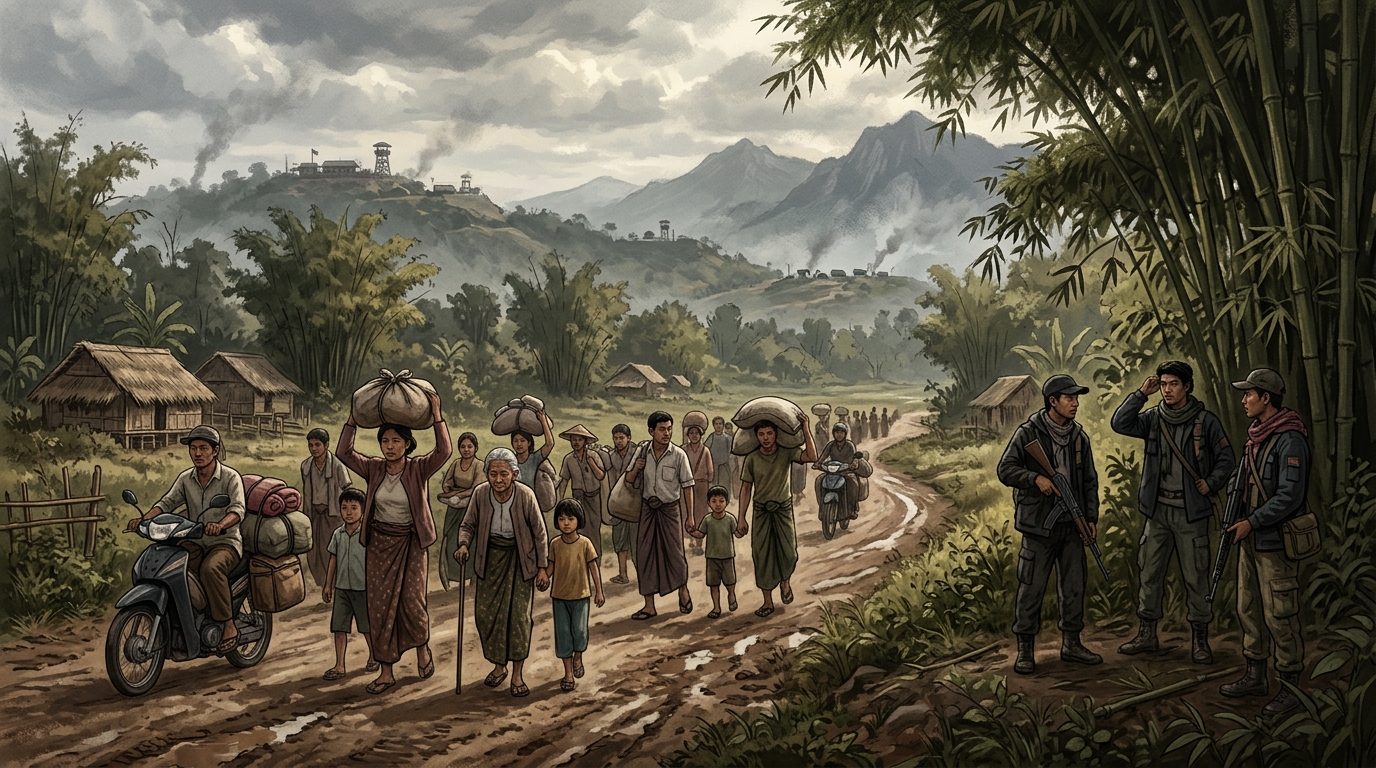
According to UNHCR figures updated in October 2026, approximately 4.05 million people were internally displaced within Myanmar.
UNICEF estimated that 16.2 million people, including 4.9 million children, required humanitarian assistance during 2026.
Airstrikes, artillery attacks, landmines, destroyed infrastructure and restrictions on humanitarian access have placed civilian communities under sustained pressure.
Schools, healthcare facilities and transport networks have been disrupted across conflict-affected regions.
The situation is particularly difficult for displaced families who face repeated movements, food insecurity and limited access to medical care.
The Rohingya crisis adds another dimension. Large numbers of Rohingya refugees remain in Bangladesh, while renewed fighting in Rakhine State continues to threaten communities inside Myanmar.
Without improved humanitarian access and civilian protection, the consequences of the conflict are likely to persist regardless of developments in national politics.
China, India, Thailand and ASEAN: Why Myanmar Matters Regionally
Myanmar occupies a strategically important position between South Asia, China and mainland Southeast Asia.
China has significant economic and security interests in the country, including cross-border trade and infrastructure associated with the China–Myanmar Economic Corridor.
Beijing also has an interest in limiting instability along its frontier and maintaining working relationships with influential actors.
India faces security and humanitarian concerns along its northeastern border with Myanmar. Armed conflict and population displacement can affect border communities, trade and regional connectivity.
Thailand is exposed to refugee movements, cross-border security incidents and economic disruption.
Bangladesh continues to face the long-term consequences of Rohingya displacement.
ASEAN has attempted to promote a negotiated response through its Five-Point Consensus, adopted in 2021. However, disagreements among the parties and continued hostilities have limited diplomatic progress.
The conflict therefore represents more than an internal political crisis. It is also a regional security challenge involving migration, trade, humanitarian assistance and competing diplomatic interests.
Future Threats: Five Scenarios to Watch
1. Continued territorial fragmentation
Myanmar could remain divided between government-administered areas, resistance-held territories and regions where authority is contested. Such fragmentation would complicate national administration and any future political settlement.
2. Intensification of air warfare
The military's continued reliance on airpower creates risks for civilians, particularly in areas where ground forces face resistance. Further attacks on civilian infrastructure could deepen displacement and international scrutiny.
3. Disputes over electoral legitimacy
The April 2027 by-elections may create further disagreements over political representation if significant opposition groups remain excluded or voting cannot take place safely in conflict-affected areas.
4. Expansion of cross-border instability
Refugee movements, armed-group activity, illicit trade and criminal networks could increase pressure on neighboring countries, particularly Thailand, India, China and Bangladesh.
5. A prolonged humanitarian emergency
Persistent fighting, economic disruption and inadequate humanitarian funding could leave millions dependent on assistance even if some regions experience temporary reductions in violence.
These are possible developments, not predictions. Their significance will depend on battlefield changes, political decisions and diplomatic engagement.
Can Myanmar Move Toward a Political Settlement?
A sustainable settlement would require addressing questions that have shaped Myanmar's politics since independence: the military's role in government, the distribution of authority between the center and ethnic regions, political representation and security guarantees.
Elections alone cannot resolve those disputes.
Any negotiated process would also face the challenge of involving multiple armed organizations whose objectives are not identical.
The military-backed government argues that constitutional institutions can provide a basis for stability. Its opponents maintain that meaningful political change requires an end to military domination and broader participation.
The coming by-elections will therefore be one development within a much larger struggle over Myanmar's political future.
For regional governments and international organizations, the immediate priorities remain civilian protection, humanitarian access, preventing cross-border escalation and encouraging credible political dialogue.
Myanmar's central fault line remains unresolved: whether political authority can be rebuilt through a negotiated and broadly accepted system, or whether competing military and political institutions will continue to divide the country.
Sources
Follow our reporting: Add Faultline Brief as a Preferred Source on Google →