Middle East's Emerging Power Blocs: Alliances, Rivalries and the Battle for Regional Influence
A geopolitical map portrays emerging alignments involving Saudi Arabia, Türkiye, Pakistan, Egypt, Iran, Israel and the UAE. But how accurately does it reflect the region's shifting strategic relationships?
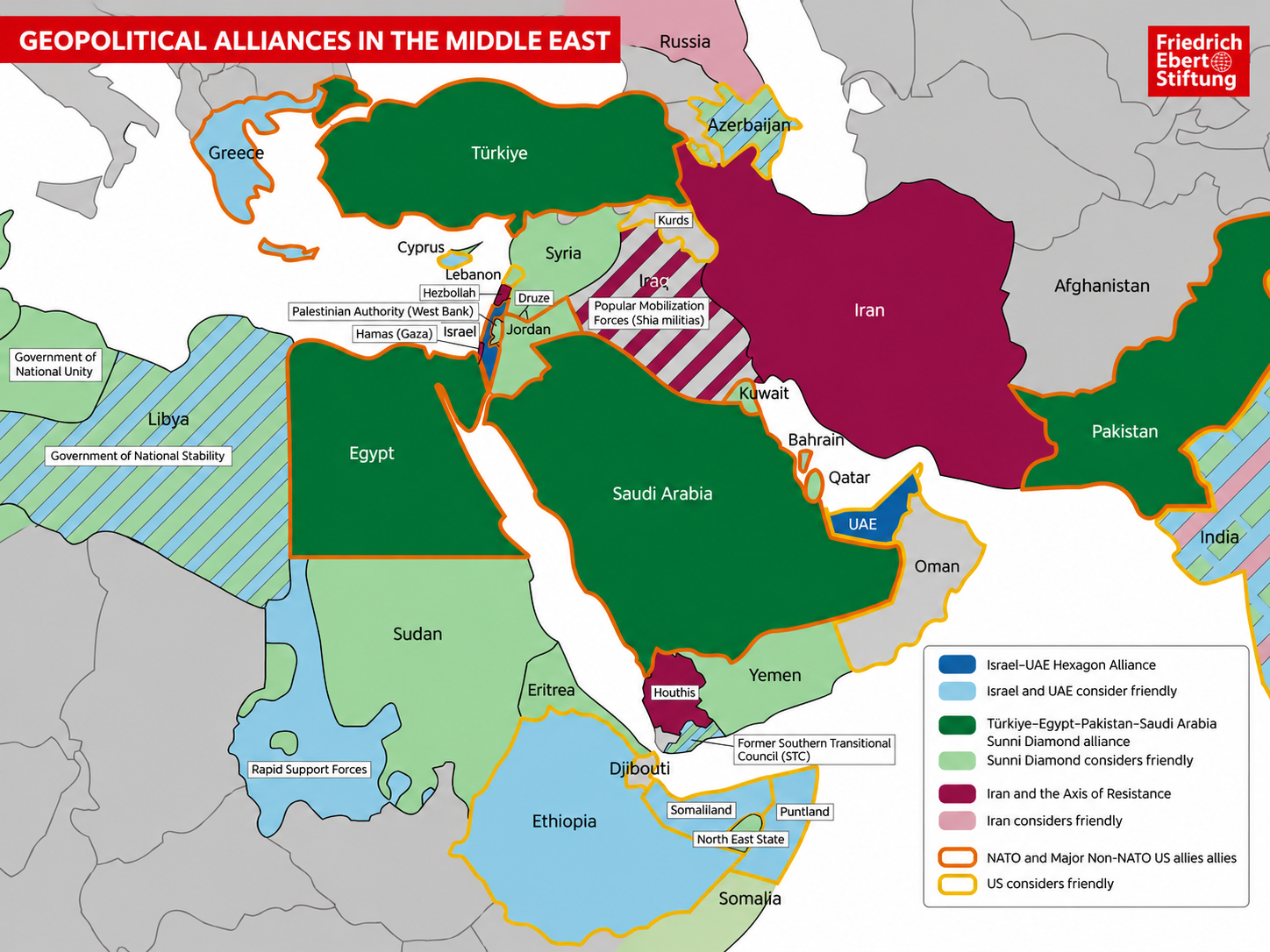
This map, attributed to the Friedrich Ebert Stiftung (FES), attempts to illustrate the emerging geopolitical alignments in the Middle East and surrounding regions. It portrays three broad power groupings centered on Saudi Arabia–Türkiye–Pakistan–Egypt, Iran, and Israel–UAE.
However, an important distinction is necessary: the map presents an interpretation of geopolitical relationships, not a verified map of formal military alliances. Several relationships are more complicated than the colors suggest.
A. The Saudi Arabia–Türkiye–Pakistan–Egypt alignment
This is the largest grouping shown on the map.
Its members possess different strategic advantages:
- Saudi Arabia: Financial resources, energy influence and religious significance.
- Türkiye: NATO membership, a substantial defense industry and regional military influence.
- Pakistan: Nuclear deterrence, a large military and longstanding defense relations with Saudi Arabia.
- Egypt: Control of the Suez Canal, a major Arab military and diplomatic influence.
The map describes this as a Sunni Diamond Alliance, but that terminology should not be mistaken for an established collective-defense organization. These countries cooperate in some areas while maintaining important differences over regional conflicts and foreign policy.
B. Iran and the Axis of Resistance
The magenta grouping represents Iran and armed organizations historically linked to Tehran, including Hezbollah, the Houthis and some Iraqi militias.
Iran has used relationships with these groups to extend its influence beyond its borders, deter adversaries and challenge US and Israeli regional power.
Nevertheless, these organizations have different objectives and varying degrees of autonomy. Their relationships with Iran should not be understood as identical.
C. Israel–UAE and the proposed Hexagon Alliance
The blue grouping suggests a strategic network centered on Israel and the United Arab Emirates.
Israel and the UAE established diplomatic relations through the 2020 Abraham Accords, creating opportunities for cooperation in trade, technology and security.
The map also places countries such as Greece, Azerbaijan and Ethiopia within a wider circle of friendly relationships.
However, the label Hexagon Alliance should be treated as an analytical characterization rather than proof of a formal six-country military pact.
Why the map matters
The most significant argument behind this map is that Middle Eastern geopolitics can no longer be explained simply as Sunni versus Shia, Arab versus non-Arab, or pro-US versus anti-US.
Instead, regional countries increasingly pursue overlapping relationships based on security, trade, energy, military technology and diplomatic interests.
For example, Pakistan maintains important ties with Saudi Arabia and Türkiye while also sharing a border and diplomatic relations with Iran. Similarly, Saudi Arabia's engagement with Iran complicates any assumption of permanently opposing blocs.
The map's presentation of Syria, Sudan, Libya and Yemen is particularly sensitive because their internal political and military divisions cannot be adequately represented by assigning a single geopolitical alignment to an entire country.
Critical limitations
Before using this map in a thesis, article or geopolitical analysis, I would flag four issues:
- No visible publication date: The geopolitical relationships depicted need to be checked against the period the map represents.
- Formal and informal relationships are mixed: Diplomatic cooperation, security partnerships, ideological affinities and military alliances are different categories.
- Some relationships are oversimplified: Pakistan, Saudi Arabia, Türkiye and Egypt do not necessarily operate as a unified geopolitical bloc.
- The legend may be misleading: A colored border or shaded territory does not establish the existence of a treaty or binding security commitment.
A possible analytical interpretation
The map can be understood as depicting a regional transition from traditional alliance structures toward flexible, overlapping and issue-specific strategic partnerships.
Saudi Arabia, Türkiye, Pakistan and Egypt represent substantial collective economic, military and diplomatic potential, but translating that potential into coordinated strategic action is another matter.
Iran's regional influence depends partly on relationships with non-state actors, while Israel and the UAE have sought opportunities for cooperation with countries beyond their immediate geographical surroundings.
The United States, Russia and China further complicate this landscape by maintaining relationships with multiple regional actors.
The central question is not simply which country belongs to which bloc, but whether these relationships could become durable security arrangements capable of reshaping the regional balance of power.
Sources
- Friedrich Ebert Stiftung
Follow our reporting: Add Faultline Brief as a Preferred Source on Google →