
Europe’s Protest Wave Deepens as Ukraine and Iran Wars Intensify Cost-of-Living Crisis
From blockaded French high schools and student marches in Milan to housing encampments in Madrid and Lisbon, a widening wave of demonstrations is exposing Europe’s domestic pressures as two major conflicts drive up energy costs and sharpen disputes over government spending.
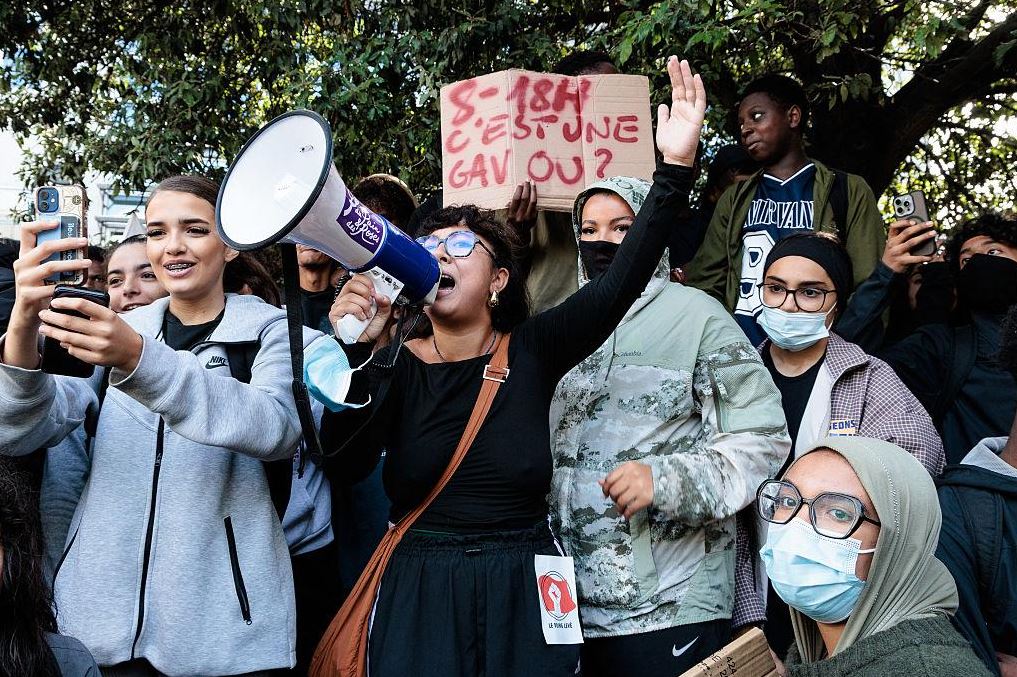
A wave of protests across Europe is bringing students, tenants, workers and pensioners onto the streets, confronting governments with demands for affordable housing, better education, higher wages and greater economic security.
The demonstrations have different origins and objectives. In France, students are challenging teacher shortages and deteriorating school conditions. In Italy, young protesters are opposing education reforms and military spending priorities. In Spain and Portugal, housing costs and tenant protections have become central political battles. In Albania, an environmental dispute has developed into a broader challenge to the government.
Yet these movements are unfolding against a common economic backdrop: the consequences of Russia’s continuing war against Ukraine and the renewed energy shock associated with the US-Israeli conflict with Iran.
The wars have increased pressure on European energy markets, contributing to inflation and raising the cost of transport, heating and everyday goods. Governments already struggling with debt and public spending demands face increasingly difficult decisions over how much support they can provide.
The result is a growing confrontation over economic priorities, with protesters questioning whether governments are doing enough to protect living standards while allocating resources to defence and security.
France: Why high schools are being blockaded
France has experienced one of the most significant waves of high school protests in recent decades.
The movement began in September in the Paris suburbs, where students complained about teaching vacancies, overcrowded classrooms and deteriorating school buildings.
It rapidly spread to other parts of the country.
By October 1, more than 1,000 schools had been affected by the demonstrations, according to reporting by Le Monde.
Students have described classes with as many as 35 pupils, prolonged absences of teachers without replacements, and uncertainty over their educational prospects.
The Parcoursup university admissions system has also become a focus of frustration among young people concerned about their futures.
In working-class suburbs such as Créteil, Saint-Denis and Sevran, the protests reflect wider concerns about unequal access to education and public services.
Education Minister Édouard Geffray acknowledged the need to hear legitimate student grievances and announced consultations with student organizations. However, the government's response has also included substantial police deployments as some demonstrations escalated into violence.
The distinction between peaceful school protests and subsequent disorder is important. The movement's educational demands should not be conflated with vandalism or attacks on police.
For many students, the underlying question is whether the state can guarantee equal educational opportunities at a time of growing economic pressure.
University fees add another concern
A separate debate concerns France's university registration fees for some international students.
A government decree issued in May 2026 tightened the rules under which universities can exempt certain non-European students from higher differentiated tuition fees beginning in the 2026–27 academic year.
The policy adds to concerns about access to higher education, although it should not be mistaken for the principal cause of the high school blockade movement.
Together, these disputes illustrate the pressures facing France's education system, from secondary classrooms to university admissions and affordability.
Italy: Milan students challenge education reforms and military spending
In Italy, students have mobilized against the education policies of Prime Minister Giorgia Meloni's government.
Thousands marched in Milan on October 16 as part of nationwide demonstrations known as No Meloni Day.
The protesters raised concerns about insufficient education funding, the condition of school buildings, rising living costs and government measures affecting the proportion of foreign-origin students in classrooms.
One particularly contentious measure involves a 30% limit on foreign-origin pupils in individual classes, which student organizations have criticized as discriminatory.
Demonstrators have also challenged higher military expenditure, arguing that schools and public services require greater investment.
This is where the conflicts in Ukraine and Iran intersect most visibly with domestic political grievances.
European governments face demands to strengthen defence capabilities amid Russia's war in Ukraine, while the conflict involving Iran has placed additional pressure on energy markets and security planning.
For student movements, the issue is not simply opposition to war. It is whether higher security spending is being accompanied by adequate investment in education, housing and public services.
Italy has also experienced serious disorder during separate demonstrations.
Unrest in Milan on October 17–18 involved damaged businesses and clashes with police. The government subsequently announced additional military deployments to support public security.
Those incidents should be distinguished from the largely peaceful student marches and their stated educational demands.
Spain: Madrid’s Puerta del Sol becomes a symbol of the housing crisis
In Spain, housing affordability has emerged as one of the most politically explosive issues.
Protesters established a tent encampment in Madrid's Puerta del Sol on September 26 following the eviction of an 87-year-old woman from her longtime home.
The demonstration quickly expanded into a wider movement demanding stronger tenant protections, limits on rising rents and government intervention in the housing market.
By October, the camp had developed into a semi-permanent protest community with facilities for food, medical assistance and meetings.
A month after the original demonstration, hundreds of protesters remained in the square.
The movement reflects deep frustration among younger Spaniards who face high rents, insecure employment and difficulties entering the property market.
Activists argue that existing housing policies have failed to prevent speculation and displacement.
The dispute has also become a major political issue ahead of Spain's November election.
Although international energy prices can worsen household budgets, Spain's housing crisis has deeper structural causes, including housing supply, rental-market pressures and the effectiveness of tenant protections.
The Iran and Ukraine conflicts have intensified the broader affordability challenge rather than created the housing shortage itself.
Portugal: Police clear Lisbon protest camp as housing anger grows
Portugal's housing demonstrations entered a new phase early on October 25 when police cleared a protest encampment from Lisbon's Rossio Square.
According to Reuters, officers dismantled tents after a march attended by thousands of people. Several protesters were arrested, and minor injuries were reported.
More than 100 tents had been erected in the square.
The police intervention followed weeks of demonstrations against rising housing costs and proposed changes to rental legislation.
Protesters oppose a bill that would facilitate evictions and remove rent caps on new leases. The legislation has passed its first parliamentary reading.
Portugal's housing affordability crisis is particularly severe.
Home prices have more than doubled since 2017, while rents for new leases have nearly doubled, according to Reuters. The Bank of Portugal estimates a nationwide shortage of approximately 300,000 homes.
For young workers and students, these conditions have made independent housing increasingly difficult to obtain.
Similar protests have taken place in Porto, where authorities previously removed another encampment.
The confrontation has raised questions about the balance between public order, the right to demonstrate and governments' responsibility to address housing insecurity.
Albania: The Flamingo Revolution challenges a luxury resort project
Albania's protest movement has developed around a different issue: the environmental and political consequences of a luxury tourism development linked to Jared Kushner, the son-in-law of US President Donald Trump.
The proposed projects involve Sazan Island and areas near the Vjosa-Narta protected wetland on Albania's Adriatic coast.
Environmental campaigners argue that development threatens sensitive habitats, including areas used by migratory birds and flamingos.
The flamingo has become a symbol of the movement, which protesters have called the Flamingo Revolution.
What began as opposition to the resort project expanded into broader criticism of Prime Minister Edi Rama's government, including questions about transparency, land ownership and the use of protected coastal areas.
Rama has defended the projects as major investments that could support tourism and economic growth.
The Albanian protests are not principally a reaction to the Ukraine or Iran wars. Their significance within Europe's wider protest wave lies in the growing willingness of demonstrators to challenge government decisions over investment, environmental protection and political accountability.
How the Ukraine and Iran wars are increasing pressure on Europe
The two conflicts are affecting European economies through different but overlapping channels.
Russia's war against Ukraine has disrupted Europe's energy security, contributed to higher defence expenditure and forced governments to reconsider long-term economic and strategic priorities.
The conflict involving Iran has added another shock.
Disruption around the Strait of Hormuz, a crucial passage for international oil and gas shipments, has placed renewed pressure on energy supplies and prices.
Higher fuel and energy costs affect far more than household utility bills.
They raise transport and manufacturing expenses, increase food distribution costs and contribute to inflation throughout the economy.
That leaves households with less disposable income for rent, education and other necessities.
In early October, EU Energy Commissioner Dan Jørgensen warned that tens of millions of Europeans could face difficult choices between heating their homes and buying food during the winter.
The warning illustrated the scale of concern over energy affordability.
For governments, the challenge is compounded by higher borrowing costs and competing demands for defence, education, welfare and infrastructure spending.
However, the relationship between international conflict and street protests is not uniform.
French students are primarily protesting educational conditions. Spanish and Portuguese tenants are challenging housing policy. Italian demonstrators are confronting both education reforms and spending priorities.
The wars amplify these pressures by making economic conditions more difficult and narrowing governments' financial room for manoeuvre.
Military spending becomes a domestic political faultline
Europe's defence debate is increasingly connected to domestic economic concerns.
Russia's invasion of Ukraine has prompted European states to expand military assistance and strengthen their own defence capabilities.
At the same time, the confrontation involving Iran has increased concerns over Middle Eastern security, maritime trade and energy supply.
These developments have strengthened arguments for greater security expenditure.
But they have also created political tensions over public budgets.
Students and trade unions in Italy have explicitly criticized increased military spending while calling for more resources for schools and public services.
This does not establish that defence expenditure is directly responsible for every education or housing shortfall.
It does demonstrate that foreign policy and national security decisions are becoming part of domestic debates over economic priorities.
As governments seek to strengthen military preparedness, they face growing pressure to explain how security commitments will be financed without further weakening public services or household purchasing power.
Are Europe’s protests becoming a single movement?
The demonstrations across Europe share themes of affordability, inequality and frustration with political leadership.
Some organizers have expressed solidarity with movements in other countries, and Italy's student mobilization has drawn inspiration from events in France and Spain.
Nevertheless, there is no evidence that all these protests form a single coordinated European uprising.
Their demands, political organizations and immediate causes remain different.
What connects them is a broader loss of confidence among sections of the public that governments can protect living standards and provide reliable public services during a period of international instability.
That discontent could become increasingly significant as Europe enters winter, when heating expenses and energy demand typically rise.
What happens next?
Several developments will determine whether the protest wave continues to expand.
In France, the government's response to teacher shortages, school conditions and student demands will be central to restoring confidence.
In Italy, the debate over education reforms, military spending and wages is likely to remain politically sensitive.
Spain faces pressure to address tenant protections and rental affordability, while Portugal's handling of housing legislation and police responses could generate further demonstrations.
Albania's government faces continuing scrutiny over the environmental and political implications of coastal development.
Beyond these domestic disputes, the direction of the wars in Ukraine and Iran will remain a major economic variable.
A further disruption to global energy supplies could increase inflation, reduce household purchasing power and intensify pressure on European governments.
Conversely, easing international tensions could help reduce some economic pressures, although it would not resolve structural housing shortages, education inequalities or longstanding public-service problems.
Europe's current unrest is therefore more than a reaction to individual government policies.
It is a test of whether European states can manage the economic consequences of international conflict while meeting the expectations of citizens who increasingly believe that their living standards and future opportunities are under threat.
Sources
Follow our reporting: Add Faultline Brief as a Preferred Source on Google →