China's Military Drills: Is Taiwan Facing a New Normal of Permanent Pressure?
As China begins another week of coastal military exercises, Taiwan watches for signs of escalation. Could Beijing's growing military and maritime presence gradually reshape the Taiwan Strait without an invasion?
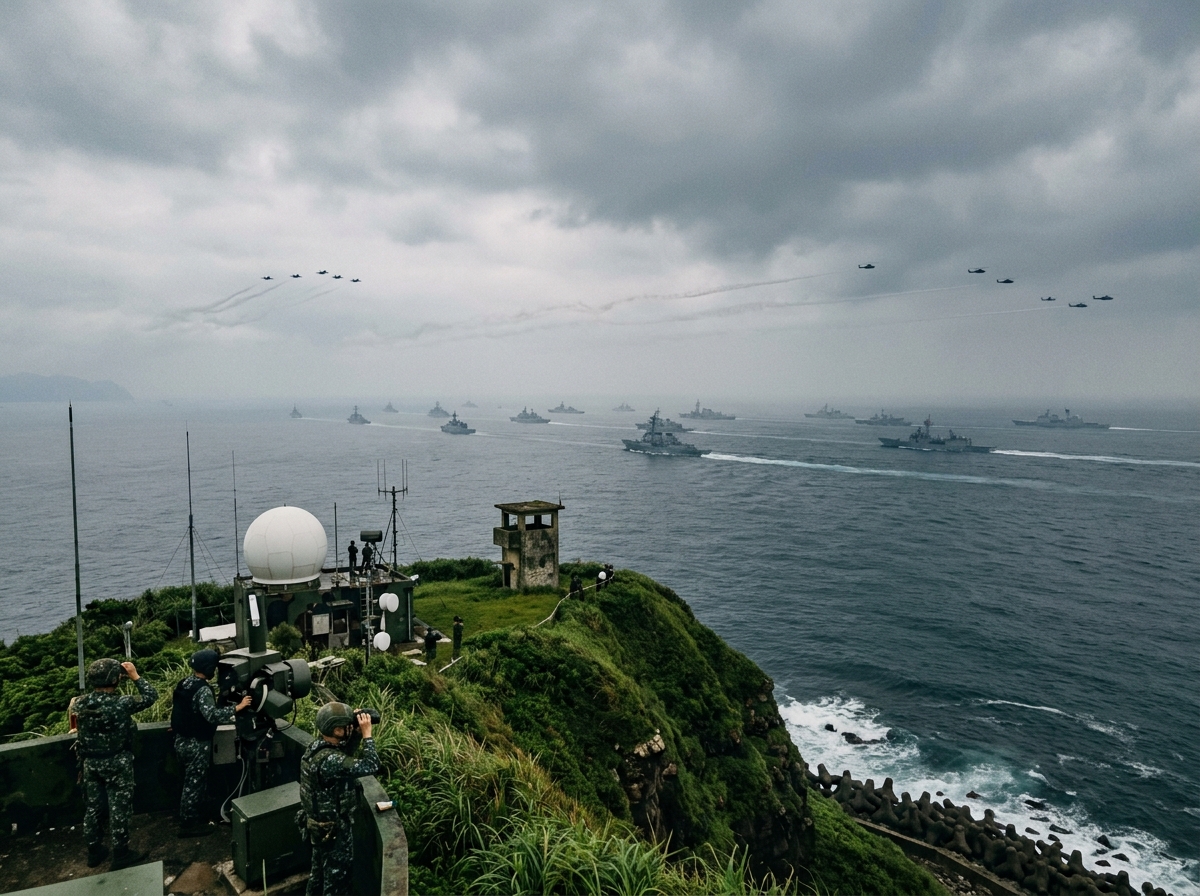
China's latest live-fire exercises are not taking place around Taiwan. That fact matters. Yet Taiwan's decision to monitor drills along China's coast highlights a larger security problem: military activity that falls short of direct confrontation can still reshape the balance of pressure across the Taiwan Strait.
The emerging faultline is not simply whether Beijing will invade. It is whether increasingly routine deployments, maritime patrols and political pressure could gradually restrict Taipei's freedom to act—without crossing the threshold of open war.
What Actually Happened on October 12?
China's Maritime Safety Administration issued notices restricting navigation in five exercise areas, spanning waters near the Bohai, Yellow, East China and South China seas. The exercises were scheduled across October 12–17.
Taiwanese Defense Minister Wellington Koo said the areas were along China's coast, with the closest off Zhejiang province, rather than directly surrounding Taiwan. His preliminary assessment pointed to coastal artillery and related units. Taiwan would nevertheless continue monitoring possible developments.
This is not evidence of an imminent blockade. Nor does every Chinese coastal exercise target Taiwan. Treating ordinary training announcements as proof of an approaching invasion would obscure the more consequential pattern: sustained military signaling in a region where intentions are disputed.
Why Are Tensions Rising Now?
The drills came after President Lai Ching-te's October 10 National Day address. Lai emphasized peace, Taiwan's democratic freedoms and its people's ability to determine their future. Beijing condemned the address as promoting separatism and warned against foreign interference.
China considers Taiwan part of its territory and has not renounced using force to pursue unification. Taiwan's government rejects Beijing's sovereignty claim and argues that its future must be decided by its people.
Beijing portrays military exercises as legitimate deterrence against separatism and outside intervention. Taipei sees the wider pattern of flights, naval deployments and coercive rhetoric as pressure on its self-government. Both positions shape how even geographically distant drills are interpreted.
There is no confirmed evidence that this week's five coastal exercise zones constitute a coordinated operation against Taiwan in response to the speech.
The Gray-Zone Problem
The greater strategic concern is activity below the level of declared war—often described as gray-zone coercion.
Warships, coast guard cutters, fishing vessels suspected of militia roles, aircraft and cyber operations can generate repeated challenges without creating a single unmistakable trigger for military retaliation.
Recent reporting described Chinese maritime activity east of Taiwan, including the detection of a suspected maritime militia vessel. Taipei fears that persistent presence could help normalize Chinese claims of operational control around sea lanes vital for resupply.
China disputes characterizations of its maritime operations as destabilizing. Nevertheless, repetition changes the strategic environment: commanders must distinguish routine movement from a possible attempt to obstruct shipping, while civilian operators must decide how much uncertainty they can tolerate.
The danger is partly psychological. When a warning is issued every day, deciding which warning deserves an exceptional response becomes harder.
Why the United States and the Region Matter
Washington maintains unofficial relations with Taipei, supports Taiwan's self-defense and opposes unilateral changes to the status quo. The precise extent of any US military intervention would depend on decisions taken during a crisis.
For Japan and the Philippines, Taiwan's security is tied to nearby sea lanes, air routes and military planning. A disruption could confront neighboring governments with difficult choices even if their territories were not directly attacked.
Regional deterrence can discourage coercion, but competing exercises and deployments also increase the risk of miscalculation. Communication and clarity about intentions are therefore security tools, not signs of weakness.
Why the World Economy Would Feel It
The Taiwan Strait is a commercial artery, not merely a military boundary. CSIS estimated that roughly $2.45 trillion in goods passed through it in 2022—more than one-fifth of global maritime trade by value.
A serious disruption would affect China as well as Taiwan and its partners. Energy shipments, manufacturing supply chains and Taiwan's semiconductor industry would all face significant uncertainty.
This mutual economic exposure can discourage confrontation. It cannot guarantee restraint, particularly if leaders believe political or strategic stakes outweigh immediate commercial losses.
What Would Signal a Real Escalation?
Geography, duration and operational behavior matter more than an alarming headline. Exercises directly encircling Taiwan, attempts to stop merchant ships, sustained exclusion zones near principal ports, or coordinated cyber and maritime interference would warrant different scrutiny from coastal artillery firing far from the island.
The task for observers is to track changes against a baseline, not label every drill the beginning of a war.
Faultline Brief Assessment
Taiwan is not demonstrably under blockade today. The October 12 drills, by Taiwan's own assessment, are along China's coast. But their significance lies in the political and military environment in which they occur.
The long-term risk is that persistent pressure makes exceptional interference seem ordinary, narrowing the space for diplomacy while increasing opportunities for error.
The next Taiwan crisis may begin not with an invasion announcement, but with a dispute over which country has the authority to control an otherwise routine passage at sea.
Preventing that outcome requires vigilance without exaggeration, credible defenses without unnecessary provocation, and channels for dialogue that remain open when tensions rise.
Sources
Follow our reporting: Add Faultline Brief as a Preferred Source on Google →